What if the greatest risk to defense capital isn't geopolitical instability, but the absence of a structured defense investment governance framework? As the U.S. national defense budget surpasses $1 trillion for fiscal year 2026, institutional investors face a landscape where regulatory hurdles like the COINS Act and ITAR often obscure the path to stable returns. It's clear that while the sector's growth is undeniable, the complexity of valuing dual-use technologies and navigating outbound investment restrictions creates a significant barrier to entry. You're likely aware that the shift from experimental AI pilots to procurement-grade deployment requires a more sophisticated approach to asset management.
This article demonstrates how institutional-grade governance transforms these high-risk ventures into resilient, high-impact asset classes. We'll outline a methodical framework for capital allocation that aligns private interests with national security priorities. Our analysis identifies high-growth niches within the $13.4 billion AI and robotics budget and provides the risk mitigation strategies necessary for long-term strategic alignment. By moving from a model of simple exclusion to one of principled stewardship, investors can secure stability in an increasingly volatile global environment.
The Evolution of Strategic Capital Allocation in Defense for 2026
The landscape of defense expenditure is undergoing a fundamental transformation. While global military budgets were once viewed primarily through the lens of sovereign spending, they now represent a structural shift toward private-sector integration. In 2026, defense has transitioned from a niche tactical play into a core institutional asset class. This evolution is driven by the need for strategic autonomy, where nations seek to secure supply chains and technological superiority through private capital mobilization. As geopolitical tensions redefine asset stability, the traditional boundaries between public duty and private investment have blurred.
Managing these sophisticated assets requires a rigorous defense investment governance framework. Traditional investment models often fail to account for the unique regulatory pressures of 2026, such as the Comprehensive Outbound Investment National Security Act (COINS Act). A private investment office acts as a global strategist in this environment. It provides the intellectual rigor needed to align long-term capital with national security objectives, ensuring that portfolios remain resilient against volatility. This governance-led approach moves beyond speculation, focusing instead on the systematic management of high-impact technologies.
From Procurement to Partnership: The New Defense Cycle
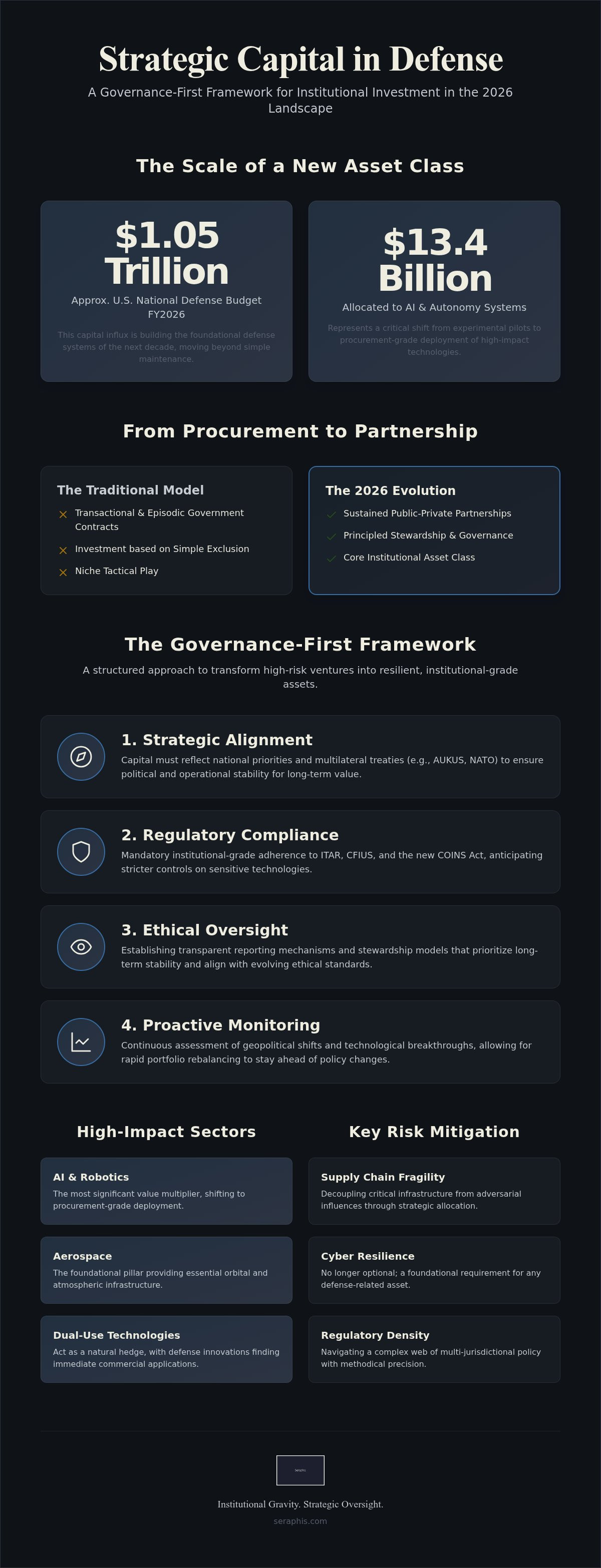
The traditional defense cycle, once defined by transactional and episodic government contracts, has evolved into a model of sustained partnership. The 2026 surge in defense infrastructure is fueled by a U.S. national defense budget reaching approximately $1.05 trillion. This capital influx isn't merely for maintenance; it's for building the foundational systems of the next decade. Strategic capital allocation is the methodical distribution of resources to ensure both financial return and national resilience. By moving beyond simple procurement, private capital now funds the very infrastructure that ensures sovereign stability. This shift allows for more predictable cash flows and long-term asset appreciation.
High-Impact Sectors: AI, Robotics, and Aerospace
The convergence of AI and robotics represents the most significant value multiplier in the 2026 defense landscape. With $13.4 billion specifically allocated to autonomy and AI systems in the U.S. budget, the focus has shifted to procurement-grade deployment. Aerospace remains the foundational pillar, providing the necessary orbital and atmospheric infrastructure for these systems to operate. The dual-use nature of these technologies acts as a hedge against sector-specific downturns. Innovations in autonomous ground vehicles or maritime systems often find immediate applications in commercial logistics. This versatility ensures that assets remain liquid and valuable across multiple economic cycles, provided they're managed under a strict governance framework.
A Governance-First Framework for Defense Investment
Managing capital in the defense sector requires more than market insight; it demands a structured approach to navigate unprecedented regulatory density. The passage of the Comprehensive Outbound Investment National Security Act (COINS Act) in late 2025 has fundamentally altered the landscape, expanding oversight into sensitive technologies across a broader list of jurisdictions. A robust defense investment governance framework is now the primary differentiator between speculative ventures and institutional-grade assets. This framework operates through four critical stages of alignment and oversight.
- Strategic Alignment: Capital must reflect national priorities and multilateral treaties such as AUKUS and NATO. Ensuring that investments support the "strategic autonomy" goals of allied nations provides a layer of political and operational stability.
- Regulatory Compliance: Institutional-grade adherence to ITAR and CFIUS standards is mandatory. With the COINS Act requiring implementing regulations by early 2027, internal vetting processes must anticipate stricter controls on high-performance computing and hypersonic systems.
- Ethical Oversight: Establishing transparent reporting mechanisms ensures that defense assets meet evolving ethical standards. This includes adopting stewardship models that prioritize long-term stability over short-term gains, similar to recent frameworks established for defense engagement.
- Proactive Monitoring: Continuous assessment of geopolitical shifts and technological breakthroughs allows for rapid rebalancing. In a year where global military spending is under intense scrutiny, staying ahead of policy changes is essential.
Implementing these steps allows a private investment office to act with the necessary precision to protect capital while supporting national resilience.
Institutional Gravity and Strategic Oversight
Seraphis Group applies a principle of institutional gravity to every defense allocation. This concept involves anchoring high-growth assets within a framework of serious intellectual rigor and global sophistication. Our Strategic Advisory role serves as the vital bridge between dormant capital and operational execution. We don't just identify niches; we ensure that every asset is governed by a long-term perspective that values stability. This methodical approach is designed for the preservation of value in sectors like AI and aerospace, where the pace of innovation often outstrips traditional management styles.
Risk Management in Global Defense Markets
Supply chain fragility remains a primary risk in 2026, especially as nations move to decouple critical infrastructure from adversarial influences. Cyber-resilience is no longer an optional feature but a foundational requirement for any defense-related asset. We approach these challenges with the methodical precision of a global strategist, evaluating multi-jurisdictional deals with a focus on sovereign security. By analyzing the intersection of policy and technology, we mitigate the risks associated with rapid shifts in export controls or international defense pacts. This ensures that defense investment governance remains a proactive tool for capital protection rather than a reactive compliance measure.
Case Study: Optimizing Capital for AI-Driven Aerospace Infrastructure
The development of a robotics-integrated aerospace hub serves as a definitive model for modern capital deployment. In this scenario, a private investment office manages the development of an autonomous logistics center designed to support unmanned aerial systems and remotely operated vehicles. This project requires a dual-track capital allocation strategy that balances high-risk research and development (R&D) with the stability of physical infrastructure. By utilizing a rigorous defense investment governance model, the office ensures that every dollar spent on software integration is anchored by the tangible value of the aerospace facility itself. This approach mitigates the volatility inherent in pure-play technology ventures while securing a critical node in national defense supply chains.
The governance model in action begins with a tiered vetting process that evaluates both technical viability and regulatory alignment. During the initial phases, the framework ensures that all autonomous systems comply with the Comprehensive Outbound Investment National Security Act of 2025. This proactive compliance prevents the "stranded asset" risk that occurs when technologies are suddenly restricted by export controls. Long-term strategic guidance then shifts toward operational stability, ensuring that the facility maintains its status as a procurement-grade asset for government agencies. The outcome is a project that delivers superior risk-adjusted returns by aligning private capital with the $13.4 billion U.S. budget for autonomy and AI systems.
Vetting AI and Robotics Assets
Evaluating the "strategic moat" of proprietary defense AI requires a shift from traditional software metrics to a focus on mission-critical reliability and interoperability. Specialized capital management is essential for scaling robotics production, as it provides the patient capital necessary to move from prototype to procurement-grade deployment. The governance premium in defense asset valuation is the quantifiable increase in long-term asset stability and regulatory resilience achieved through institutional-grade oversight. This premium reflects the reduced risk profile of an asset that is already aligned with national security priorities and international treaties.
Strategic Development and Infrastructure Resilience
Critical infrastructure projects are the necessary foundations for autonomous systems, providing the physical security and connectivity required for AI-driven operations. These hubs don't exist in isolation; they often integrate banking and pharmaceutical logistics to create cross-sector resilience. For example, a secure aerospace hub can facilitate the rapid transport of temperature-sensitive medical supplies or high-value financial data, leveraging defense-grade security for commercial applications. Strategic guidance ensures the project meets 2026 global standards for cyber-resilience and supply chain integrity. This methodical approach closes the loop between capital investment and national resilience, creating an asset that is as durable as it is innovative.
Navigating Regulatory and Ethical Hurdles in 2026
The perceived conflict between defense allocation and ethical mandates has been largely reconciled through a fundamental reframing of the sector. In 2026, sophisticated investors no longer view defense as a standalone industry, but as a critical component of national infrastructure and resilience. The European Commission's December 2025 clarification played a pivotal role in this shift. By confirming that sustainable finance legislation is sector-neutral, the Commission ensured that defense assets aren't inherently excluded from ESG-aligned products. This allows institutional capital to support sovereign stability while adhering to rigorous ethical standards.
Navigating the global landscape requires a nuanced understanding of divergent regulatory environments. In the United States, the Comprehensive Outbound Investment National Security Act (COINS Act), signed in late 2025, has introduced stricter oversight for sensitive technologies. Meanwhile, European markets focus on aligning defense with sustainable finance taxonomy, and Asian jurisdictions are rapidly implementing domestic technology protection controls. Maintaining stakeholder trust in this complex environment depends on a transparent defense investment governance framework. It's the only way to demonstrate that capital is managed with a sense of duty and methodical precision.
Compliance as a Competitive Advantage
Mastering ITAR and CFIUS regulations facilitates faster deal execution, turning regulatory fluency into a tangible edge. Investors who understand the 450-day implementation window of the COINS Act regulations can anticipate shifts in capital flow before they occur. This is the essence of principled institutional leadership. By avoiding the pitfalls of retail-grade compliance, which often lacks the depth required for specialized defense markets, institutional offices can secure assets that others find too complex to vet. It's about moving with speed and certainty in a high-barrier environment.
Ethical Standards and Strategic Alignment
Developing a philosophical alignment between private capital and global security is the hallmark of a global strategist. This is particularly vital when managing the advancement of AI. The Welsh Government's September 2026 announcement of a specific ethical framework for defense engagement highlights the growing demand for accountability. Mitigating reputation risk requires more than just compliance; it demands a proactive stewardship model. By ensuring that every technological advancement is governed by clear ethical boundaries, you can protect long-term asset value. Align your capital with these rigorous standards through our strategic governance services.
Seraphis Group: Your Partner in Strategic Defense Governance
In an environment where the U.S. national defense budget has surpassed the $1 trillion threshold, the requirement for sophisticated capital management has never been more paramount. Seraphis Group serves as the logical partner for professional stakeholders who prioritize stability and long-term strategic alignment over speculative gains. Our expertise isn't limited to identifying emerging niches; it's rooted in the systematic application of a defense investment governance framework that protects capital against the inherent volatility of the 2026 geopolitical landscape. We provide the intellectual rigor necessary to manage high-impact assets in AI, robotics, and aerospace, ensuring that every allocation supports national resilience. We prioritize stability in every decision.
Our commitment to institutional-grade oversight ensures that private capital operates with the same precision as the systems it funds. By maintaining a global vision and a sense of duty, we help our partners navigate the complex intersection of policy, technology, and finance. We invite professional stakeholders to explore a partnership rooted in methodical precision and a shared commitment to sovereign security.
Beyond Brokerage: The Private Investment Office Advantage
A specialized investment partner is essential for the defense sector, where assets are frequently subject to intense regulatory scrutiny and long-term procurement cycles. Unlike retail brokerage services that often focus on high-volume, short-term transactions, Seraphis Group operates as a private investment office dedicated to institutional gravity. This distinction allows us to provide cross-sector insights that are unavailable to generalist firms. We analyze the convergence of defense technology with banking, healthcare, and infrastructure to identify dual-use opportunities that offer superior resilience. Our strategic guidance isn't reactionary. It's built on a foundation of long-term value preservation and philosophical alignment with global security standards.
Initiating a Strategic Partnership
Engaging with Seraphis Group on defense infrastructure projects follows a tiered, logical sequence designed to ensure operational clarity and regulatory compliance. The process begins with a comprehensive assessment of strategic objectives and an analysis of the specific regulatory hurdles associated with 2026's export controls. We then transition into a structured advisory phase where our global strategists provide methodical guidance on asset selection and governance implementation. This thorough onboarding ensures that every partnership is built on a foundation of transparency and mutual duty. It's a deliberate path toward securing a resilient position in a complex market.
Contact Seraphis Group for Strategic Investment Insights
Securing Long-Term Resilience in the Global Defense Landscape
The transition of defense from a niche sector to a core institutional asset class demands a fundamental shift in perspective. Successful capital allocation in 2026 requires more than simply identifying technological trends; it necessitates a rigorous commitment to defense investment governance. By aligning private capital with national strategic priorities and stringent regulatory standards, investors can transform potential volatility into operational stability. The convergence of AI and aerospace infrastructure provides a unique opportunity for those who prioritize methodical precision and institutional gravity over speculative gains.
Seraphis Group operates as a specialized private investment office, offering deep expertise in high-impact AI and aerospace sectors. Our global institutional governance framework is designed to bridge the gap between capital and operational execution. We ensure that every asset is managed with a focus on long-term value preservation and strategic alignment. We provide the intellectual rigor needed to navigate multi-jurisdictional complexities with understated confidence.
Request a Strategic Briefing on Defense Capital Allocation
We look forward to supporting your efforts to build a resilient and impactful portfolio in this vital sector.
Frequently Asked Questions
What is the primary role of strategic governance in defense investment?
Strategic governance ensures that capital is aligned with national security priorities and international treaties like AUKUS. It provides a structured framework to manage geopolitical volatility and regulatory complexity. By implementing institutional-grade oversight, governance transforms high-risk defense assets into stable, long-term investments. This systematic approach reduces the risk of stranded assets and ensures that every allocation supports national resilience while delivering predictable risk-adjusted returns.
How does Seraphis Group manage regulatory risks like CFIUS and ITAR?
Seraphis Group employs methodical precision to navigate multi-jurisdictional regulations, including the Comprehensive Outbound Investment National Security Act of 2025. We maintain a proactive compliance posture by monitoring the 450-day implementation window for new Treasury regulations. This ensures that all defense allocations meet institutional-grade ITAR and CFIUS standards. Our approach anticipates regulatory shifts, allowing professional stakeholders to execute deals with speed and certainty in high-barrier environments.
Can defense investments align with modern ESG and ethical mandates in 2026?
Defense investments are increasingly viewed as foundational components of national infrastructure and resilience rather than traditional armaments. The European Commission's 2025 clarification confirms that sustainable finance legislation is sector-neutral, allowing defense assets to be integrated into ESG-aligned portfolios. By adopting a stewardship model focused on transparency and ethical oversight, investors can support sovereign stability while meeting the evolving ethical standards established by governments and institutional partners.
What makes AI and robotics 'critical infrastructure' in the defense sector?
AI and robotics have transitioned from experimental pilots to procurement-grade deployment, supported by a $13.4 billion allocation in the FY 2026 U.S. defense budget. These systems form the backbone of autonomous logistics, maritime surveillance, and unmanned aerial operations. Because they provide the essential capabilities required for modern national defense, they're treated as critical infrastructure. Investing in these assets requires a robust defense investment governance framework to ensure operational interoperability and long-term asset value.
How does a private investment office differ from a retail brokerage in defense capital allocation?
A private investment office focuses on long-term strategic guidance and institutional gravity rather than high-volume retail transactions. Unlike retail brokerages, Seraphis Group provides specialized capital management that integrates cross-sector insights from banking, healthcare, and infrastructure. We don't offer personal financial planning or public mutual funds. Instead, we act as a global strategist, aligning sophisticated capital with sovereign security needs through a tiered, logical sequence of advisory and oversight.
What are the projected defense spending trends for NATO members in 2026?
NATO members are significantly increasing their defense expenditures to meet strategic autonomy goals, with the total U.S. national defense budget for FY 2026 reaching approximately $1.05 trillion. European nations are also expanding their budgets to bolster the continent's defense technology ecosystem. These trends indicate a structural shift toward procurement-ready AI systems and space-based infrastructure. This growth creates a stable environment for institutional capital, provided that investments are managed under a disciplined governance framework.
How does Seraphis Group evaluate dual-use technologies for institutional portfolios?
We evaluate dual-use technologies by analyzing their mission-critical reliability and their potential for cross-sector application in commercial markets like pharmaceutical logistics or banking. This versatility acts as a hedge against sector-specific downturns. Our evaluation process focuses on the strategic moat of proprietary AI and its alignment with global security standards. By prioritizing technologies with both defense and commercial utility, we ensure that portfolios remain liquid and resilient across multiple economic cycles.
What is the importance of aerospace infrastructure in a global investment strategy?
Aerospace infrastructure serves as the foundational pillar for modern defense, providing the orbital and atmospheric systems necessary for global connectivity and data transmission. In a global investment strategy, these assets offer long-term stability and predictable cash flows due to their role in supporting national security. Effective defense investment governance ensures that aerospace projects meet 2026 standards for cyber-resilience and supply chain integrity, securing their position as high-impact, institutional-grade assets.


