
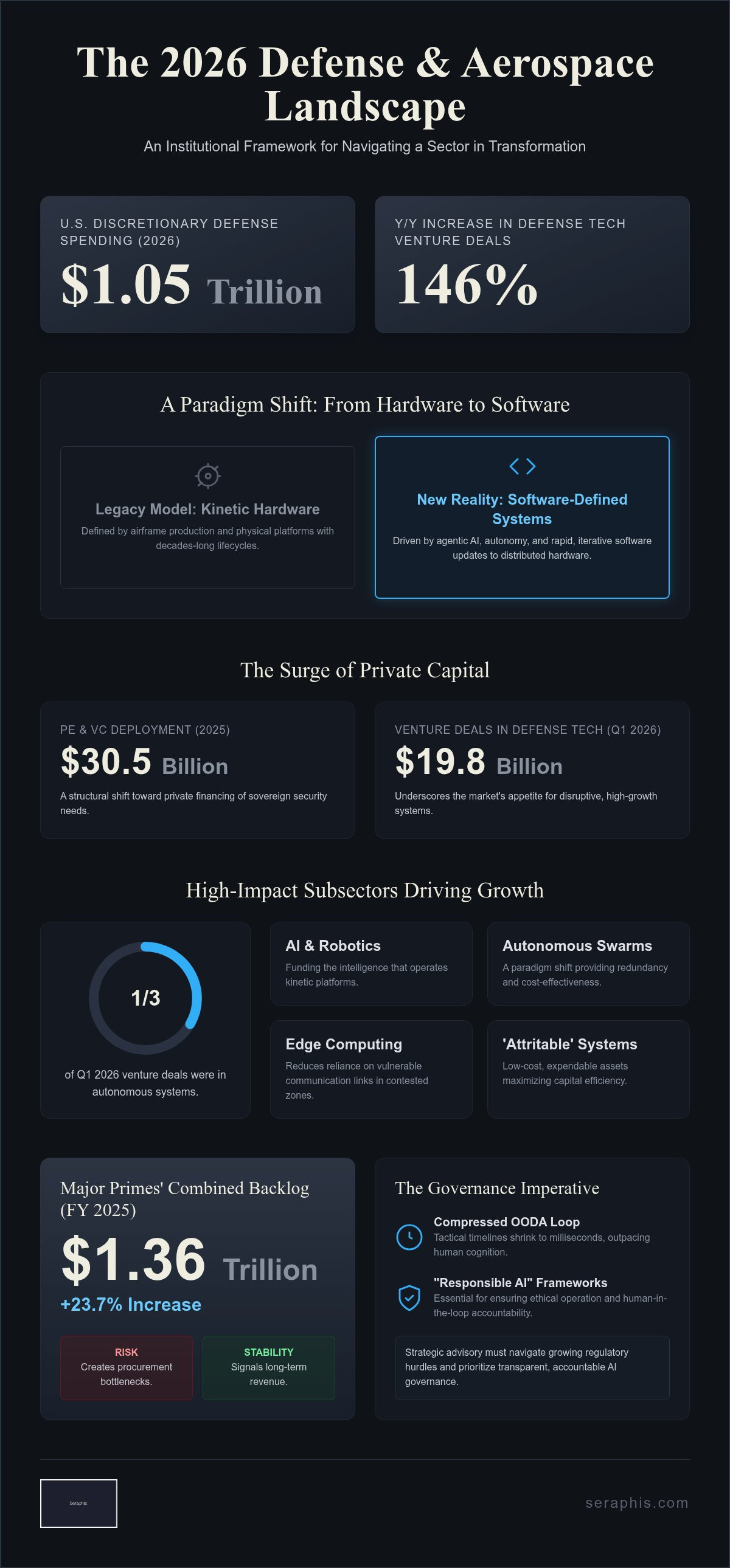
With U.S. discretionary national defense spending reaching $1.05 trillion in 2026, the intersection of private capital and national security has moved beyond traditional procurement into a territory of unprecedented complexity. Most institutional investors recognize that the rapid convergence of agentic AI and autonomous systems creates a landscape where yesterday's due diligence is no longer sufficient. It's clear that the traditional model of capital deployment is struggling to keep pace with a 146% year-over-year increase in defense technology venture deals. This environment demands a sophisticated defense and aerospace advisory approach that prioritizes strategic governance over mere transactional support.
This analysis provides an institutional-grade framework for navigating the risks of technological obsolescence and opaque regulatory shifts, such as the latest FAA mandates on supersonic flight and spaceport siting. You'll find a methodical approach to capital allocation that mitigates geopolitical volatility while identifying high-impact innovation hubs. We'll examine the necessary transition from broad-market consultancy to a governance-led partnership model designed specifically for the 2026 fiscal environment.
The 2026 Defense and Aerospace Landscape: A Strategic Overview
Global markets have transitioned into a period where capital deployment is increasingly dictated by software capabilities rather than kinetic hardware alone. The aerospace manufacturing industry is no longer defined solely by airframe production but by the integration of agentic AI and autonomous control systems. With U.S. discretionary national defense spending reaching $1.05 trillion in 2026, the scale of investment opportunities has expanded significantly. Private equity and venture capital managers deployed $30.5 billion across the sector in 2025, reflecting a structural shift toward private financing of sovereign security needs. It's clear that sovereign states are looking to private capital to bridge the innovation gap created by traditional, slower-moving procurement cycles. This shift requires a sophisticated defense and aerospace advisory approach that understands the convergence of commercial viability and national interest.
Drivers of Sector Volatility and Opportunity
Rapid AI deployment has compressed traditional aerospace lifecycles from decades to years. This acceleration forces a rigorous reevaluation of asset stability; technological obsolescence can occur before a platform reaches full operational capacity. Venture capital deals in defense technology reached $19.8 billion in the first quarter of 2026, a 146% year-over-year increase that underscores the market's appetite for disruptive systems. Dual-use technologies have emerged as a primary investment thesis, offering pathways for capital to support both commercial aviation recovery and military modernization. Technological resilience in 2026 is defined as the capacity of an organization to maintain operational continuity and strategic superiority through the rapid, iterative integration of software-driven updates across distributed hardware platforms.
Geopolitical Alignment and Sovereign Infrastructure
Geopolitical fragmentation is driving the creation of localized aerospace investment hubs as nations prioritize strategic autonomy. Sovereign states are looking to private investment offices to finance critical infrastructure, such as the priority launch corridors outlined in the August 2026 National Space Transportation Policy. Specialized defense and aerospace advisory is now required to navigate the complexities of international export controls and evolving regulatory frameworks that impact cross-border projects. Aligning capital with these shifting standards is a core component of Strategic Investment Advisory: Institutional Frameworks for 2026. Effective advisory ensures that investments remain compliant with new FAA directives while capitalizing on the industry's broader move toward reshoring and dual-sourcing strategies. This methodical alignment helps mitigate the risks associated with the five largest defense primes closing fiscal year 2025 with a combined backlog of $1.36 trillion, a 23.7% increase that creates both bottleneck risks and long-term revenue stability.
High-Impact Subsectors: AI, Robotics, and Autonomous Systems
The 2026 investment landscape is increasingly defined by the integration of robotic hardware with sophisticated artificial intelligence. According to the 2026 Aerospace and Defense Industry Outlook, autonomous systems accounted for nearly one-third of the $19.8 billion in defense technology venture deals recorded in the first quarter of 2026. This data underscores a fundamental shift in how private capital is deployed within the sector. Investors aren't just funding platforms; they're funding the intelligence that operates them. Effective defense and aerospace advisory is essential for identifying which of these technologies offer long-term asset stability versus those destined for rapid obsolescence.
Edge computing has become a critical component of this evolution. By processing data at the sensor level, aerospace systems reduce their reliance on vulnerable communication links, which is vital in contested environments. This technical shift supports the rise of 'attritable' systems, which are low-cost, expendable assets designed to be lost in combat without causing significant financial or operational ruin. Capital efficiency in this subsector is maximized when the cost of the autonomous effector is significantly lower than the value of the target it neutralizes.
Robotics and the Future of Kinetic Systems
The transition from manned platforms to autonomous swarms represents a paradigm shift in kinetic engagement. These swarms provide a level of redundancy and cost-effectiveness that traditional legacy systems can't match. For a private investment office, managing capital for high-growth robotics startups requires a deep understanding of both technical feasibility and military mission requirements. It's vital that Private Capital for Aerospace Technology: A Strategic Investment Framework is applied to these ventures to ensure long-term governance and ethical alignment.
AI Governance in Defense Applications
As combat systems become more autonomous, the regulatory hurdles surrounding AI governance become more pronounced. Strategic defense and aerospace advisory must prioritize 'Responsible AI' frameworks to ensure that systems operate within ethical boundaries and international law. The OODA loop in this context refers to the cycle of observing, orienting, deciding, and acting at speeds that exceed human cognitive capacity, effectively compressing the tactical timeline to milliseconds. Governance ensures these accelerated decisions remain transparent and accountable to human oversight. Investors seeking to align their portfolios with these standards should consider the strategic governance services offered by specialized offices to navigate these complex ethical landscapes.
Strategic Governance: The Core of Aerospace Capital Allocation
Governance serves as the primary mechanism for mitigating the idiosyncratic risks associated with high-stakes defense contracts and multi-year procurement cycles. While the previous sections detailed the surge in sector spending, capital alone doesn't guarantee asset stability. Effective defense and aerospace advisory focuses on establishing rigorous oversight frameworks that protect private capital from the volatility of shifting political administrations and technological disruptions. With the five largest defense primes holding a combined backlog of $1.36 trillion at the start of 2026, the challenge for investors isn't finding opportunities, but ensuring the operational transparency required to manage such scale.
Within the 2026 investment environment, the "Social" pillar of ESG has undergone a significant redefinition. It's no longer just about corporate responsibility; it's about the ethical deployment of autonomous systems and the preservation of sovereign security as a foundational social good. Investors now require frameworks that align their portfolios with these evolving standards, ensuring that high-impact technologies like agentic AI remain under strict human-centric governance. This alignment is critical for maintaining institutional reputation while pursuing high-impact returns in sectors that are increasingly scrutinized by international regulatory bodies.
The Aerospace and defense deals outlook indicates that deal value in the first quarter of 2026 reached an estimated $11.3 billion, reflecting a market that rewards structured, transparent capital deployment. For a private investment office, this underscores the necessity of a governance-led approach to M&A and portfolio management. Strategic governance is the systematic application of oversight and ethical alignment that transforms operational transparency into a measurable competitive advantage for institutional investors.
Frameworks for Long-Term Capital Stability
Designing governance structures that survive multi-decade aerospace cycles requires a shift from quarterly milestones to long-term strategic alignment. Institutional investors must implement oversight mechanisms that ensure project accountability even as underlying technologies evolve. By establishing clear reporting lines and ethical guardrails, private offices can provide the stability necessary for complex projects to reach maturity. A detailed exploration of these methods is available in our guide on Strategic Capital Allocation in Defense: A Governance-Led Framework for 2026.
Risk Management in Critical Infrastructure
Assessing the vulnerability of space-based communication and navigation has become a priority following the issuance of the National Space Transportation Policy (NSPM-17) in August 2026. This policy, which supports over 1,000 annual launches by 2030, places immense pressure on existing orbital infrastructure. Managing the correlation between these defense assets and global market shocks requires a diversified approach to capital allocation. Advisory must account for the physical security of assets and the digital resilience of the networks that support them, ensuring that infrastructure remains operational during periods of geopolitical friction.
Criteria for Evaluating Defense and Aerospace Advisory Partners
Selecting a partner for defense and aerospace advisory requires a departure from traditional selection criteria that prioritize brand recognition over specialized capability. In an era where U.S. defense spending has reached $1.05 trillion, the complexity of the sector demands an advisor with a 'Global Strategist' mindset. This persona doesn't merely track market trends; they synthesize geopolitical volatility, regulatory shifts, and technological breakthroughs into a coherent narrative for capital protection. High-impact innovation often resides in private-market niches that generalist firms overlook. Consequently, an advisor's value is measured by their access to these specialized hubs and their ability to vet the underlying technology with clinical precision.
Technical vs. Strategic Proficiency
Technical proficiency is non-negotiable. An advisor must understand the engineering constraints of hypersonic propulsion or the latency requirements of agentic AI to provide meaningful guidance. This 'physics-first' approach prevents capital from being trapped in platforms that are theoretically sound but operationally unviable. Cross-sector insights are equally valuable; for instance, the robotics expertise found in healthcare investment strategies often mirrors the precision required for autonomous defense systems. Similarly, infrastructure models from the banking sector can inform the financing of spaceport siting and launch corridors. For a deeper look at these technical intersections, refer to our analysis on Defense Technology Capital Allocation: A Strategic Framework for 2026.
Alignment with Private Office Objectives
Private investment offices operate under distinct constraints that retail-focused firms often fail to grasp. While a generalist consultancy might focus on short-term operational efficiency, a specialized partner prioritizes strategic governance and long-term asset stability. This alignment ensures that every decision supports the office’s broader mission and ethical standards. Use the following checklist for initial advisory partner due diligence:
- Verified Access: Does the partner have documented deal flow in autonomous systems and aerospace infrastructure?
- Regulatory Depth: Can they demonstrate expertise in navigating 2026 FAA mandates and international export controls?
- Geopolitical Integration: Is there a clear methodology for incorporating geopolitical risk into capital allocation?
- Governance Standards: Do they offer institutional-grade frameworks that prioritize transparency and accountability?
Choosing the right partner is the most critical decision an institutional leader makes in this sector. If you are seeking to align your capital with a principled institutional leader, consider the defense and aerospace advisory services provided by Seraphis Group to ensure your portfolio remains resilient against technological and geopolitical shifts.
The Seraphis Approach: Specialized Advisory for Global Strategists
Seraphis Group operates as a specialized private investment office, providing a level of philosophical alignment that broad-market consultancies often fail to replicate. Our defense and aerospace advisory is rooted in the systematic integration of high-level investment insights with rigorous strategic governance. We don't view these high-impact sectors in isolation. Instead, we analyze them as components of a comprehensive global investment strategy designed to prioritize long-term stability over the volatility of public markets. By focusing on critical fields such as agentic AI, autonomous robotics, and sovereign aerospace infrastructure, we ensure that our institutional partners remain positioned at the forefront of technological evolution.
Our Methodology for High-Impact Sectors
The optimization of cross-sector outcomes is a core pillar of our methodology. We leverage deep industry knowledge from diverse high-precision fields, such as healthcare and pharmaceuticals, to enhance defense-related capital allocation. The sophisticated capital management required for pharmaceutical innovation often mirrors the long-term, high-stakes development cycles found in aerospace technology. This cross-pollination of expertise allows us to apply proven governance models across varied portfolios, ensuring a consistent standard of intellectual rigor and risk mitigation. For a more granular view of these applications, our framework on Private Capital for Defense: Strategic Framework 2026 provides a tiered approach to sovereign technology investment.
Strategic Partnership, Not Retail Brokerage
Seraphis Group maintains a disciplined focus on private equity and global strategy, deliberately excluding retail brokerage or personal financial planning from our service model. This specialization allows us to act as a composed, strategic authority for institutional leaders who require more than transactional support. We navigate the complexities of the 2026 regulatory landscape, including evolving FAA mandates and international export controls, with methodical precision. By acting as a seasoned partner in the management of critical infrastructure, we provide the transparency and accountability necessary to secure high-impact returns. Our approach is designed for the global strategist who values a principled institutional leader over a casual business partner. Seraphis Group provides the stable, intellectual rigor required for the 2026 defense landscape.
Navigating the Strategic Horizon of Sovereign Technology
The transition toward software-defined defense and autonomous robotics necessitates a fundamental reassessment of how private capital interacts with national security. Success in 2026 depends on more than just identifying high-impact innovation; it requires a governance-led framework that ensures long-term asset stability amidst rapid technological obsolescence. Institutional leaders must prioritize partnerships that offer both technical proficiency and a sophisticated understanding of geopolitical alignment. Specialized defense and aerospace advisory provides the necessary bridge between private investment objectives and the complex requirements of sovereign infrastructure.
By utilizing institutional-grade strategic governance and our global investment strategy expertise, investors can mitigate the risks of a fragmented global market while securing high-impact returns. We invite you to Explore Strategic Advisory with Seraphis Group to leverage our specialized focus on AI and robotics integration. Building a resilient aerospace portfolio is a methodical process that rewards those who prioritize intellectual rigor and strategic autonomy. We look forward to supporting your pursuit of long-term stability and technological leadership in this critical sector.
Frequently Asked Questions
What is the primary role of defense and aerospace advisory for private capital?
The primary role of defense and aerospace advisory is to provide institutional-grade analysis for navigating the convergence of AI, robotics, and global investment. Advisory partners help private capital identify high-impact innovation hubs while mitigating the risks of geopolitical volatility and technological obsolescence. By focusing on strategic governance, these advisors ensure that capital allocation remains aligned with long-term sovereign security requirements and ethical standards across distributed hardware platforms.
How does AI impact strategic capital allocation in the defense sector?
Artificial intelligence shifts the focus of capital allocation from traditional kinetic hardware to software-defined capabilities. In the 2026 fiscal environment, investors prioritize agentic AI and edge computing that enable autonomous decision-making at the sensor level. This technological evolution drives the rise of 'attritable' systems, which are low-cost assets designed for high-risk environments. Capital management must account for these compressed lifecycles to avoid investing in platforms that face rapid obsolescence.
Why is strategic governance more important than operational consulting for investors?
Strategic governance is essential because it provides the institutional oversight necessary to survive multi-decade aerospace cycles. Unlike operational consulting, which focuses on short-term efficiency, governance prioritizes ethical alignment, transparency, and asset stability. It acts as a primary risk-mitigation tool against shifting political administrations and regulatory changes. This approach ensures that a private investment office maintains its reputation while pursuing high-impact returns in sectors that face intense international scrutiny.
Can private investment offices participate in critical aerospace infrastructure?
Private investment offices play an increasingly vital role in financing critical aerospace infrastructure. With the National Space Transportation Policy supporting over 1,000 launches annually by 2030, there's significant demand for private capital in spaceport siting and priority launch corridors. Specialized defense and aerospace advisory helps these offices navigate complex FAA mandates and international export controls. This participation allows institutional investors to secure high-value assets that support both commercial aviation and national defense capabilities.
What are the risks of investing in robotics within the defense sector for 2026?
Investing in robotics for the defense sector involves significant risks related to technological obsolescence and evolving regulatory frameworks. The rapid 146% year-over-year increase in defense tech venture deals in early 2026 highlights a market that moves faster than traditional procurement cycles. Investors face the challenge of vetting autonomous swarms that must comply with 'Responsible AI' standards. Without rigorous strategic governance, capital can easily be trapped in hardware that fails to meet new international ethical or technical requirements.
How does Seraphis Group differentiate its advisory from retail brokerage services?
Seraphis Group operates as a specialized private investment office and doesn't provide retail brokerage, personal financial planning, or publicly traded mutual funds. Our model focuses exclusively on high-impact sectors like defense, aerospace, and AI through a lens of strategic governance. We prioritize the needs of global strategists who require institutional-grade investment insights rather than broad-market transactional support. This disciplined focus ensures our advisory remains objective, transparent, and aligned with long-term institutional objectives.
Is aerospace investment considered a long-term or short-term strategy?
Aerospace investment is fundamentally a long-term strategy that requires patience and methodical planning. Development and procurement cycles for critical infrastructure and defense platforms typically span several decades, making them unsuitable for short-term speculative capital. Success in this sector rewards investors who implement global investment strategies focused on asset stability and technological resilience. By aligning capital with multi-year government budgets, such as the $1.05 trillion U.S. defense appropriation for 2026, offices can achieve stable, high-impact growth.
What are 'Dual-Use' technologies and why are they important for advisory?
Dual-use technologies are innovations with both commercial and military applications, such as autonomous flight systems or advanced robotics. These technologies are vital for advisory because they offer a broader market for capital recovery and reduce the risk associated with single-customer defense contracts. Advisory frameworks prioritize dual-use platforms to ensure that investments remain resilient across shifting geopolitical landscapes. This approach allows capital to support commercial aviation recovery while simultaneously contributing to the modernization of sovereign defense infrastructure.

