
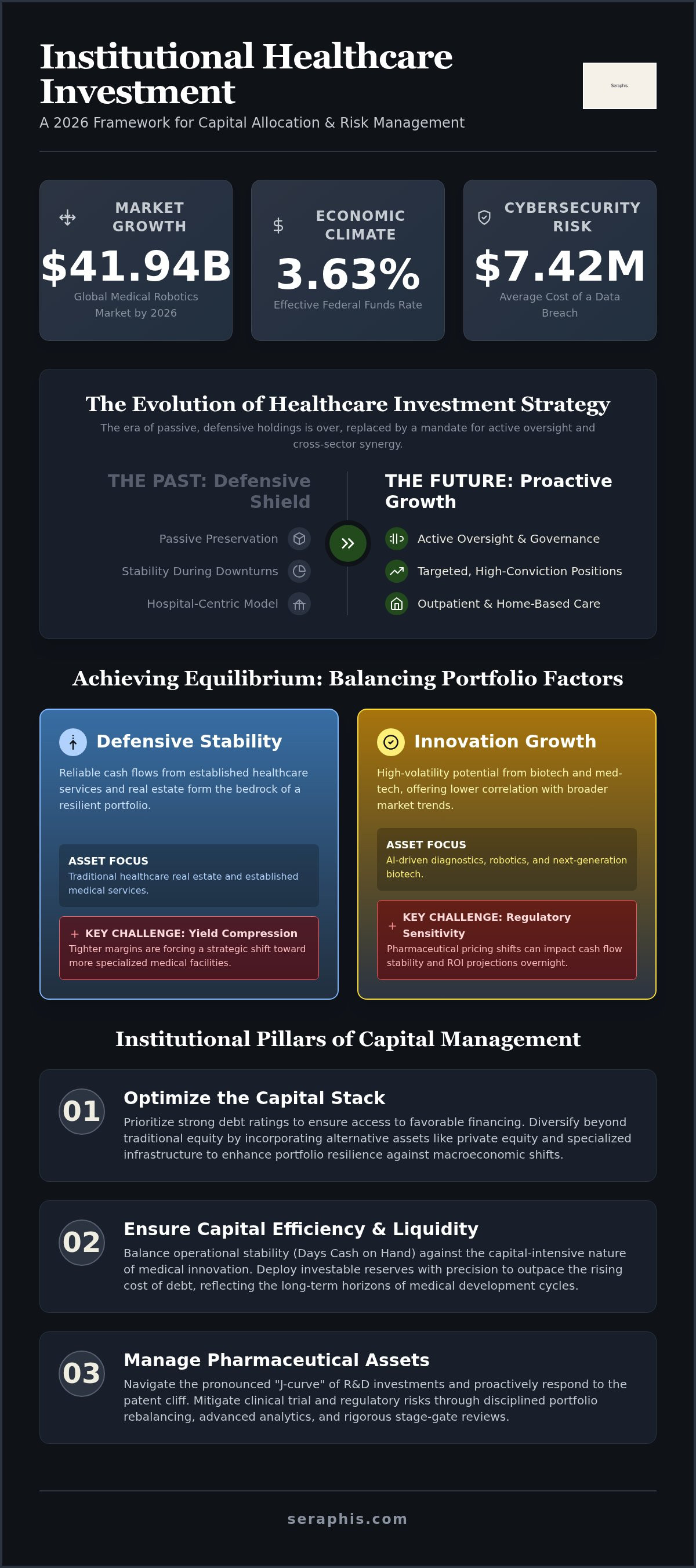
With the global medical robotics market reaching approximately $41.94 billion in 2026, the traditional distinction between healthcare provision and industrial technology has effectively collapsed. Institutional investors recognize that maintaining a resilient healthcare investment strategy now requires a sophisticated understanding of how AI integration and robotics intersect with shifting pharmaceutical pricing regulations. Strained margins, exacerbated by an effective federal funds rate of 3.63 percent and the complexities of the One Big Beautiful Bill Act, have made disciplined capital allocation more critical than ever. It's a period where the cost of data breaches, averaging $7.42 million, necessitates a shift from speculative growth to principled institutional governance.
You likely understand that the era of passive, defensive healthcare holdings is over, replaced by a requirement for active oversight and cross-sector synergy. This article provides the institutional frameworks required to manage the intersection of medical innovation, regulatory shifts, and high-impact capital allocation. We'll examine a clear framework for capital efficiency and offer insights into the synergies between healthcare and tech. By the end of this briefing, you'll possess the strategic tools to improve the governance of your healthcare assets while addressing the regulatory uncertainties of the current year.
The Evolution of Healthcare Investment Strategy
A robust healthcare investment strategy serves as a systematic framework for the allocation of capital across medical services, advanced technology, and pharmaceuticals. Historically, institutional investors categorized this sector as a defensive shield designed to provide stability during economic downturns. However, the transition into a post-pandemic, tech-heavy economy has redefined these parameters. Proactive growth has replaced passive preservation as the primary objective for sophisticated capital. By late 2026, the traditional hospital-centric model is facing significant disruption as care delivery moves toward outpatient and home-based environments. Private investment offices are increasingly essential in this environment, providing the patient, disciplined capital required to navigate complex regulatory shifts and high-impact medical innovations.
Healthcare as Critical Infrastructure
Modern healthcare systems are now viewed through the lens of national security and social resilience, occupying a strategic position similar to energy or defense infrastructure. This shift is driven by the realization that a nation's economic stability is inextricably linked to its public health capacity. Demographic trends in developed markets continue to accelerate, creating a permanent increase in long-term capital demand for specialized care. Within this framework, a healthcare investment strategy is a multi-dimensional framework for balancing social impact with institutional returns. As the global healthcare industry expands its digital footprint, the integration of cybersecurity and physical infrastructure has become a primary mandate for institutional governance.
Defensive Stability vs. Innovation Growth
Strategic capital management in 2026 requires a precise balance between the reliable cash flows of established healthcare services and the high-volatility potential of biotech and med-tech. The current interest rate environment has fundamentally altered the valuation models for these assets. With the effective federal funds rate at 3.63 percent as of September 2026, the cost of capital for major healthcare infrastructure projects has risen, necessitating more rigorous due diligence. Investors must carefully analyze the following factors to maintain portfolio resilience:
- Yield Compression: Traditional healthcare real estate is seeing tighter margins, forcing a shift toward specialized medical facilities.
- Tech Integration: High-growth assets in AI and robotics often require longer horizons but offer lower correlation with broader market volatility.
- Regulatory Sensitivity: Pharmaceutical pricing remains a variable that can impact cash flow stability overnight.
Achieving equilibrium between these forces ensures that a portfolio remains resilient against inflationary pressures while capturing the upside of medical breakthroughs. The focus has moved from broad market exposure to targeted, high-conviction positions in sub-sectors that demonstrate clear operational efficiency.
Institutional Pillars of Healthcare Capital Management
The execution of a successful healthcare investment strategy requires a disciplined approach to capital efficiency and liquidity management. As interest rates stabilize at 3.63 percent, institutional leaders must optimize investable reserves to outpace the rising cost of debt. Maintaining adequate Days Cash on Hand (DCOH) remains a priority for operational stability, yet this liquidity must be balanced against the capital-intensive nature of medical innovation. It's no longer sufficient to hold cash in low-yield vehicles; instead, capital must be deployed with a precision that reflects the long-term horizons of medical development cycles. Diversified strategic governance frameworks help manage the inherent volatility of pharmaceutical assets, providing a necessary buffer against clinical and regulatory shifts.
Optimizing the Capital Stack
Large-scale healthcare systems must prioritize the management of their debt ratings to ensure continuous access to favorable financing. A sophisticated capital stack often incorporates alternative assets, such as private equity or specialized infrastructure, to provide diversification beyond traditional equity markets. For a deeper analysis of these structures, investors should review our guide on Strategic Investment Advisory: Institutional Frameworks for 2026. By integrating non-correlated assets, institutions can enhance portfolio resilience against macroeconomic fluctuations. Those seeking strategic governance guidance can better navigate these complex allocation decisions and ensure their capital structure remains robust.
Pharmaceutical Asset Management
Pharmaceutical growth investments often follow a pronounced J-curve, where significant upfront R&D expenditures precede eventual market returns. Navigating the 2026 landscape requires a proactive response to the patent cliff, as several blockbuster medications face increased generic competition. Institutional frameworks must account for these revenue transitions through disciplined portfolio rebalancing and the integration of advanced analytics to predict market entry timelines. Strategic governance mitigates clinical trial failure risks by implementing rigorous stage-gate reviews and cross-sector risk assessment protocols. According to the Top Investment Considerations for Healthcare Systems, managing these innovation cycles is paramount for maintaining long-term fiscal health. It's vital that investors don't overlook the impact of regulatory shifts on pharmaceutical pricing, which can alter the projected ROI of a healthcare investment strategy within a single fiscal quarter.
The Intersection of AI, Robotics, and Healthcare
The convergence of advanced robotics and artificial intelligence represents a paradigm shift in how institutional capital is deployed within the sector. While many market participants treat technology and medical services as distinct silos, a comprehensive healthcare investment strategy recognizes their functional interdependence. The application of defense-grade automation to surgical environments and pharmaceutical manufacturing is no longer speculative; it's a fundamental component of operational resilience. By integrating these high-impact fields, institutions can mitigate the risks associated with traditional service models while capturing the efficiencies of the digital frontier. This synergy is particularly evident in the transition toward autonomous systems that enhance both clinical precision and administrative throughput.
Robotics Industry Synergies
With the global medical robotics systems market valued at approximately $41.94 billion in 2026, autonomous systems are increasingly utilized to address persistent labor shortages in institutional settings. These technologies extend beyond the operating theater into automated pharmaceutical manufacturing and diagnostic imaging. Strategic advisory for robotics market entry now prioritizes systems that offer clear clinical integration and scalable technology platforms. The growth of autonomous diagnostic tools allows for higher throughput and greater precision, reducing the administrative burden on clinical staff. Investors who focus on these synergies can achieve a more stable return profile by targeting companies that solve structural inefficiencies through mechanical precision.
Artificial Intelligence in Pharmaceuticals
The global AI in healthcare market, projected to reach between $36.67 billion and $51.20 billion in 2026, is fundamentally altering the economics of drug discovery. AI-driven platforms are reducing the capital requirements and timeframes necessary to bring new therapeutics to market, specifically benefiting mid-cap pharmaceutical firms that lack the massive R&D budgets of global leaders. These tools enable personalized medicine and genomic sequencing at a scale previously considered unattainable. However, the integration of these systems requires robust governance models to ensure ethical data management and maintain patient trust. Governance frameworks must prioritize transparency and methodical precision to navigate the complexities of genomic data sets.
Beyond discovery, digital resilience has emerged as a critical business imperative. With the average cost of a healthcare data breach rising to $7.42 million globally, protecting critical infrastructure is a core requirement of any strategic framework. The synergy between defense-grade cybersecurity and medical applications provides a unique opportunity for private investment offices to leverage cross-sector expertise. By securing the data pipelines that power AI and robotics, institutions protect their underlying assets and ensure the continuity of care in an increasingly volatile digital landscape. This methodical approach to digital security reinforces the stability of the entire healthcare investment strategy, preventing the erosion of margins through unforeseen systemic shocks.
Managing Risk and Governance in Healthcare Portfolios
Risk management within a modern healthcare investment strategy extends beyond the mitigation of clinical failures or market volatility. It involves the construction of a comprehensive governance framework that ensures long-term value preservation through ethical and philosophical alignment. Institutional portfolios in 2026 face unique pressures, including the integration of AI and robotics alongside heightened scrutiny of pharmaceutical pricing models. A private investment office serves as the central authority in this context, providing the methodical precision required to manage cross-sector correlations between banking, technology, and healthcare assets. By prioritizing strategic governance, institutions can navigate these complexities without compromising their foundational investment principles.
Regulatory Resilience Frameworks
The global regulatory environment in 2026 is defined by a shift toward standardized data protection and aggressive pricing transparency. In the United States, the One Big Beautiful Bill Act (OBBBA) has introduced significant permanent tax changes and adjustments to healthcare funding, requiring a proactive adaptation of capital allocation models. Simultaneously, EU markets have tightened pricing regulations for innovative therapeutics, directly impacting the revenue projections of biopharmaceutical holdings. Adapting to these changes requires a framework that mirrors the rigor found in other high-stakes sectors. Investors should consider how these principles overlap with other critical industries by reviewing our analysis of Private Capital for Defense: Strategic Framework 2026. This cross-sector perspective is essential for managing the technological dependencies that now define modern medical infrastructure.
Ethical Governance and Social Impact
Aligning institutional capital with global health outcomes is no longer an optional component of ESG compliance; it's a prerequisite for professional stakeholders. Transparency in asset management ensures that capital deployment remains consistent with the broader social mission of healthcare provision. The composition of a composed, strategic authority in healthcare governance is defined by the synthesis of intellectual rigor, long-term vision, and an unwavering commitment to ethical standards in capital allocation. This principled approach prevents the erosion of trust that often accompanies rapid technological adoption or aggressive cost-cutting measures. For institutions seeking to refine their oversight, our team provides specialized expertise in strategic governance and capital management to ensure every asset remains aligned with institutional objectives.
Managing these risks effectively requires a steady, methodical rhythm of assessment. It's not enough to react to policy changes as they occur. Instead, a successful strategy anticipates the trajectory of global health policy and positions capital in sub-sectors that demonstrate structural resilience. By maintaining a focus on transparency and ethical alignment, institutional leaders can ensure that their portfolios don't just survive regulatory shifts but actually thrive within them. This level of strategic oversight is what distinguishes a seasoned institutional leader from a casual market participant in the complex 2026 landscape.
Seraphis Group: Strategic Governance for Healthcare Assets
In an environment where the boundaries between medical innovation and technological infrastructure have effectively collapsed, the private investment office emerges as the optimal partner for sophisticated capital management. Seraphis Group provides a specialized platform where intellectual rigor and long-term vision converge to address the complexities of the global healthcare sector. Our methodology doesn't treat sub-sectors in isolation; instead, it integrates deep insights from AI, robotics, and pharmaceutical development to create a cohesive healthcare investment strategy. This approach ensures that capital is deployed with a clear understanding of cross-sector correlations, protecting portfolios from the systemic shocks that often disrupt less integrated models.
Specialized Capital Management
Our strategic advisory services are designed for institutional leaders who require more than just market exposure. We provide a level of strategic governance that prioritizes philosophical alignment and ethical standards, ensuring that every asset contributes to the overarching objectives of the private client. By focusing on high-impact fields such as automated pharmaceutical manufacturing and AI-driven diagnostics, we deliver institutional-grade insights without the friction or misalignment often found in retail brokerage environments. The Seraphis advantage is rooted in an understated confidence; it's a stability born from methodical precision and a commitment to a global perspective. We don't make rushed decisions, but rather follow a structured path that values transparency and principled leadership.
Next Steps in Healthcare Strategy
Developing a resilient healthcare portfolio for the latter half of the decade requires a move away from passive allocation toward active, strategic oversight. As regulatory environments continue to shift under the influence of the One Big Beautiful Bill Act and global pricing standards, the need for seasoned expertise becomes paramount. Engaging with Seraphis Group allows sophisticated investors to leverage a deep reservoir of industry knowledge, ensuring their assets are positioned at the nexus of innovation and stability. Whether your focus is on the integration of robotics into critical infrastructure or the management of pharmaceutical R&D cycles, our team provides the guidance necessary to drive sustainable growth.
To begin a formal dialogue regarding your institutional objectives, we invite you to inquire about Seraphis Group’s Healthcare Investment Insights. Establishing a robust healthcare investment strategy in 2026 is a deliberate process that begins with a shared commitment to excellence and a clear-eyed assessment of the global landscape. We look forward to providing the strategic framework required to navigate the intersection of medical innovation and capital allocation with precision and duty.
Securing Institutional Resilience in the 2026 Healthcare Landscape
The transition toward a more integrated, technology-dependent medical sector requires a fundamental shift in how institutional capital is managed. A successful healthcare investment strategy in 2026 must move beyond traditional risk mitigation to embrace the synergies of AI and robotics within pharmaceutical and clinical infrastructure. By prioritizing strategic governance and capital efficiency, organizations can effectively navigate the complexities of rising debt costs and regulatory transitions introduced by the One Big Beautiful Bill Act. This period of disruption offers a unique opportunity for those who value long-term stability and methodical precision in their allocation decisions.
Seraphis Group remains committed to providing the intellectual rigor and professional transparency necessary for sophisticated private investment offices. We are specialized in high-impact AI and robotics integration, offering global strategic governance that reflects our brand's institutional gravity. We invite you to Explore Strategic Healthcare Insights with Seraphis Group to align your portfolio with the long-term horizons of medical innovation. With a principled approach to capital management, your institution is well-positioned to thrive in the years ahead.
Frequently Asked Questions
What are the primary drivers of healthcare investment strategy in 2026?
The primary drivers include demographic shifts, the integration of AI and robotics, and significant regulatory adjustments under the One Big Beautiful Bill Act. The global medical robotics market, valued at $41.94 billion, represents a central pillar of this evolution. Investors are increasingly focused on outpatient models and home-based care delivery to improve operational efficiency. A robust healthcare investment strategy now prioritizes solutions that address labor shortages and administrative waste to maintain resilient institutional margins.
How does AI impact the risk profile of pharmaceutical investments?
AI reduces clinical risk by improving drug discovery success rates and optimizing R&D expenditures, particularly for mid-cap pharmaceutical firms. The global AI in healthcare market is projected to reach up to $51.20 billion in 2026, allowing for more precise genomic sequencing. However, the average cost of a healthcare data breach has risen to $7.42 million, necessitating a focus on digital resilience. Strategic governance ensures that AI implementation remains ethical and aligned with institutional risk tolerances.
What is the difference between a private investment office and a retail brokerage for healthcare?
A private investment office provides specialized strategic governance and global investment strategies tailored for sophisticated clients, whereas a retail brokerage typically focuses on transactional volume. Seraphis Group explicitly avoids retail brokerage services and publicly traded mutual funds. Instead, the firm offers institutional-grade insights into high-impact fields like robotics and pharmaceuticals. This structure ensures that capital management is aligned with long-term institutional goals rather than mass-market financial products.
How can healthcare systems optimize their capital efficiency in a high-rate environment?
Institutions can optimize capital efficiency by balancing investable reserves against an effective federal funds rate of 3.63 percent. Strategic capital management involves maintaining adequate Days Cash on Hand while deploying capital into technology with a clear ROI, such as revenue cycle automation. Restructuring debt and diversifying into non-correlated assets, such as private equity or infrastructure, helps outpace the rising cost of capital. This approach ensures operational stability without sacrificing the potential for long-term growth.
What role does robotics play in modern healthcare asset management?
Robotics serves as a critical tool for operational de-risking by automating labor-intensive processes in surgical and pharmaceutical settings. The medical robotics market is expected to grow significantly, reaching over $157 billion by 2034, making it a cornerstone of modern infrastructure. These systems solve structural labor shortages and improve diagnostic precision, which leads to more predictable cash flows. Asset managers prioritize robotics platforms that offer scalability and seamless clinical integration to ensure long-term portfolio resilience.
How do regulatory shifts in 2026 affect healthcare investment returns?
Regulatory shifts, specifically the One Big Beautiful Bill Act (OBBBA), impact returns by altering tax structures and pharmaceutical pricing models. The increase in the SALT deduction cap to $40,400 and permanent tax provisions create a complex fiscal environment for healthcare providers. Investors must use scenario planning to navigate potential cuts to Medicaid or shifts in drug pricing legislation. Methodical assessment of these policy changes is essential to protect institutional margins and maintain projected yield.
Why is strategic governance critical for healthcare infrastructure projects?
Strategic governance ensures that large-scale infrastructure projects remain aligned with national security and social resilience standards. It provides the intellectual rigor necessary to manage complex timelines and diverse stakeholders within the healthcare sector. Principled governance mitigates the risks of clinical trial failures and technological obsolescence by implementing disciplined review protocols. This level of oversight is vital for maintaining the institutional gravity required to attract and preserve sophisticated capital in volatile global markets.
Can healthcare investments serve as a hedge against inflation in 2026?
Healthcare investments often serve as a hedge against inflation due to the inelastic demand for medical services and the ability to adjust pricing in specialized sub-sectors. In 2026, the sector's correlation with critical infrastructure provides a buffer against currency devaluation and macroeconomic instability. While biotech remains volatile, established healthcare services offer stable cash flows that typically keep pace with inflationary pressures. A diversified portfolio that includes robotics and AI-driven pharma assets further enhances this defensive characteristic.
