
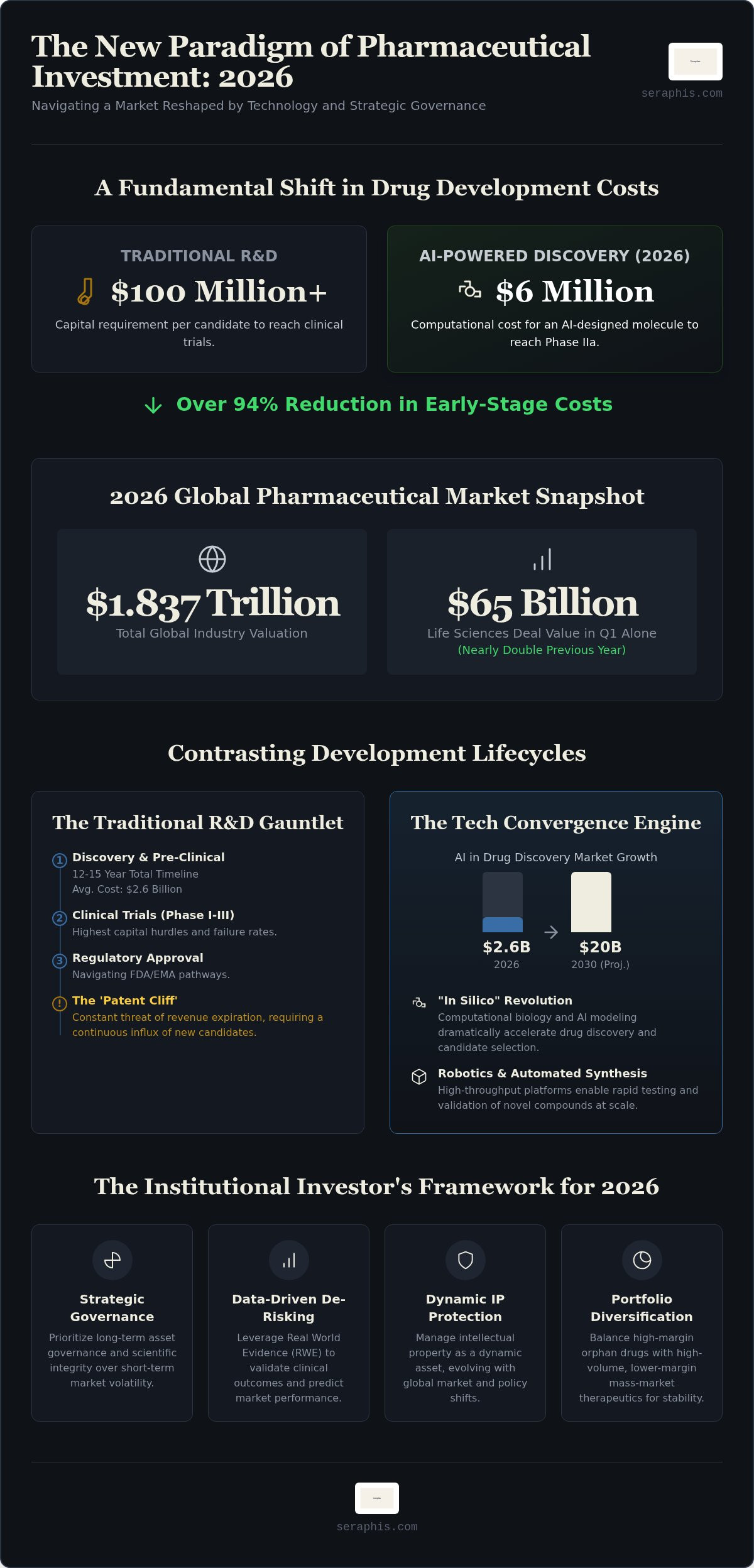
The traditional paradigm of drug development, characterized by multi-year timelines and capital requirements exceeding 100 million dollars per candidate, was fundamentally challenged in 2026 when an AI-designed molecule reached Phase IIa trials at a computational cost of only 6 million dollars. This stark reduction in entry costs signifies a structural shift in how capital is deployed across the life sciences. Sophisticated investors understand that while the potential for outsized returns is vast, the sector's inherent volatility, driven by clinical trial uncertainty and a 100 percent tariff on many imported patented drugs, requires a more disciplined approach to pharmaceutical investment advisory.
You've likely observed that valuing early-stage biotech pipelines has become increasingly difficult as regulatory shifts and geopolitical pressures reshape the global landscape. This overview establishes a rigorous framework for evaluating these assets by prioritizing technological integration and long-term strategic governance. We'll explore the convergence of AI and robotics in drug discovery and define the institutional models that allow a private investment office to maintain stability in a market projected to reach 1.837 trillion dollars this year.
The Evolution of Pharmaceutical Investment Advisory in 2026
The discipline of pharmaceutical investment advisory has transitioned from a focus on traditional manufacturing cycles to a sophisticated model of asset governance. In the current fiscal year, the global pharmaceutical industry is valued at approximately 1.837 trillion dollars, reflecting a market that has moved beyond mass-market generics toward high-impact biotechnology and precision medicine. This evolution requires institutional capital to adopt a more rigorous analytical framework that accounts for rapid technological convergence and shifting global trade policies.
2026 represents a definitive turning point for global healthcare investment strategy. The first quarter alone saw deal values in the life sciences sector reach 65 billion dollars, nearly doubling the activity recorded in the previous year. For a private investment office, managing these opportunities isn't about chasing speculative trends; it's about understanding the multi-sector correlations between healthcare, artificial intelligence, and robotics. This systemic approach ensures that capital allocation remains resilient even as clinical trial complexities increase.
Defining Strategic Capital Management in Life Sciences
Effective governance requires a move away from speculative trading toward a structured healthcare investment strategy. Sophisticated investors prioritize long-term asset governance over short-term volatility, focusing on the underlying scientific integrity and operational scalability of a pipeline. This institutional-grade perspective is vital because the cost of traditional drug development remains high, often requiring years of patient capital before a commercial milestone is reached. A private investment office provides the necessary intellectual rigor to distinguish between temporary market sentiment and enduring clinical value.
Macro Trends Impacting Pharmaceutical Advisory
Global demographic shifts continue to underpin the fundamental demand for advanced therapeutics as aging populations in developed markets require increasingly complex chronic care solutions. Simultaneously, we're seeing a move toward regulatory harmonization across major global investment markets, which simplifies the path for international clinical trials but increases the stakes for compliance. The necessity for professional pharmaceutical investment advisory becomes clear when examining these overlapping pressures. High-impact pharmaceutical investment in 2026 is defined as the strategic allocation of capital toward clinical assets that leverage computational biology and automated synthesis to address historically intractable pathologies while maintaining rigorous governance standards.
Evaluating the Pharmaceutical Value Chain: R&D and Clinical Risk
Assessing the pharmaceutical research and development landscape requires a fundamental shift from singular asset evaluation to a comprehensive portfolio logic. Traditional models indicate that bringing a new drug to market costs approximately 2.6 billion dollars and can span 12 to 15 years. Professional pharmaceutical investment advisory must therefore account for the looming 'Patent Cliff,' where multi-billion dollar revenue streams expire, necessitating a constant influx of novel candidates to sustain institutional valuations. This cycle of expiration and innovation drives the need for a diversified approach to capital allocation.
Managing clinical risk involves more than just scientific validation; it requires sophisticated capital management and strategic diversification. By utilizing accelerated FDA and EMA approval pathways, investors can shorten the timeline to commercialization, provided the underlying clinical data is robust. For those seeking investment insights that balance these clinical complexities with market realities, a methodical approach to governance is non-negotiable. This ensures that capital isn't just deployed but is actively managed through every regulatory milestone.
De-risking Clinical Development Phases
Phase II and III trials represent the most significant capital hurdles in the life sciences sector. Modern advisory frameworks now incorporate Real World Evidence (RWE) to validate clinical outcomes beyond controlled environments, providing a clearer picture of an asset's eventual market performance. This data-driven approach allows for more precise valuation of orphan drugs, which often command higher margins despite smaller patient populations, compared to the high-volume, low-margin dynamics of mass-market therapeutics. Identifying the right balance between these two categories is essential for maintaining a stable long-term portfolio.
Intellectual Property and Governance
Intellectual property remains the bedrock of pharmaceutical value. In a globalized market, a patent portfolio is only as strong as the governance model protecting it. Strategic governance ensures that intellectual property is not just a legal shield but a dynamic asset that evolves with market shifts and trade policy changes. This level of oversight is essential for high-stakes ventures where the margin for error in regulatory compliance is non-existent. A principled institutional leader focuses on the long-term viability of these patents, ensuring they withstand the pressures of international competition and local regulatory shifts.
Technological Convergence: AI and Robotics in Modern Drug Development
The integration of artificial intelligence and robotics has transitioned from a speculative venture to a core pillar of pharmaceutical investment advisory. In 2026, the global market for AI in drug discovery is valued at approximately 2.6 billion dollars, with projections suggesting a trajectory toward 20 billion dollars by 2030. This growth is driven by the "In Silico" revolution, where computational models predict molecular behavior before a single physical sample is synthesized. For institutional investors, this shift represents a fundamental change in capital efficiency, as the discovery and computational cost for specific candidates has dropped from traditional nine-figure sums to under 10 million dollars in verified pilot cases.
Identifying high-impact sectors requires a focus on where technology directly addresses historical inefficiencies. High-throughput screening, once a manual and error-prone process, is now dominated by automated robotic systems that operate with 24-hour precision. This technological convergence allows for the rapid identification of viable compounds, significantly reducing the "time-to-market" that has long burdened life science portfolios. A sophisticated pharmaceutical investment advisory framework prioritizes these automated workflows, as they provide a more predictable return on research and development spend compared to traditional laboratory methods.
AI-Driven Drug Discovery as an Investment Category
Evaluating AI platforms requires a different set of metrics than traditional biotech firms. Instead of focusing solely on laboratory headcount, advisory firms now assess the quality of proprietary datasets and the scalability of the underlying algorithms. Data integrity is the new "clinical integrity"; without clean, high-fidelity data, even the most advanced AI platform cannot produce viable candidates. Strategic guidance for these assets involves balancing the high growth potential of "platform-as-a-service" models with the steady value of companies that own the entire discovery-to-clinical pipeline.
Robotics and Precision Manufacturing
Robotics provides a critical solution to the supply chain vulnerabilities and new tariff frameworks introduced in 2026. By moving toward localized, automated production facilities, pharmaceutical companies can bypass the 100 percent tariffs on certain imported APIs while maintaining rigorous quality standards. The Robotics-Pharma Synergy represents the integration of autonomous synthesis and high-throughput screening to create a closed-loop development cycle that minimizes human error and maximizes capital throughput. This shift toward "right-shoring" ensures that manufacturing remains resilient in the face of geopolitical volatility, protecting the long-term value of the investment.
A Framework for Selecting a Pharmaceutical Investment Advisory Partner
Professional pharmaceutical investment advisory requires a synthesis of clinical rigor and financial acumen. In an environment where the rising cost of clinical trials is cited as a top challenge by 55 percent of industry leaders, a partner must possess deep domain expertise in both the scientific validity of a molecule and the capital market dynamics that fund it. This dual focus ensures that investment decisions aren't based on surface-level metrics but on a thorough understanding of the drug development lifecycle and its inherent biological risks.
A proven track record in global investment strategy implementation is equally critical. As trade measures like the new 100 percent pharmaceutical tariffs reshape manufacturing incentives, a partner must demonstrate the ability to navigate complex cross-border regulatory shifts. This includes providing access to cross-sector insights in fields like defense and infrastructure, which often share the same technological foundations in robotics and advanced materials. These intersections are where the most resilient long-term value is often discovered.
Institutional vs. Retail Advisory Models
Sophisticated capital requires the specialized focus of a private investment office rather than the generalized approach of retail-centric models. Retail structures often lack the depth required to evaluate the scientific nuances of a Phase III trial or the complexities of a "right-shoring" manufacturing strategy. Instead, an institutional strategic investment advisory framework provides the stability and clarity necessary for long-term asset governance. For those managing substantial allocations, obtaining strategic investment insights from a dedicated office ensures alignment with institutional goals rather than short-term market sentiment.
Due Diligence and Ethical Standards
In 2026, the "Social License to Operate" has become a measurable component of healthcare valuation. Ethical governance and transparency are no longer peripheral; they're central to mitigating the risk of regulatory intervention and public scrutiny. A robust advisory partner implements transparent reporting frameworks that allow for strategic oversight across the entire portfolio. This principled approach is integrated into the pharmaceutical investment advisory process to protect the long-term reputation and financial viability of ventures in a highly transparent global market. Methodical precision in due diligence ensures that every asset aligns with the broader mission of the investment office.
The Seraphis Group Perspective: Strategic Governance in Life Sciences
Seraphis Group approaches the life science sector through a lens of methodical precision and institutional gravity. Our methodology isn't based on chasing market sentiment but on the implementation of a rigorous Global Investment Strategy that accounts for the specific complexities of the 2026 pharmaceutical market. By combining deep-sector expertise in pharmaceuticals with our broader capabilities in Private Equity and Strategic Governance, we provide a level of oversight that generalist firms can't replicate. This structured path ensures that capital is deployed with a clear vision for long-term resilience rather than short-term gain.
Our commitment to pharmaceutical investment advisory is reflected in our focus on high-impact fields that drive global outcomes. We recognize that the pharmaceutical market, projected to reach 1.837 trillion dollars this year, requires more than just capital; it requires a principled institutional leader to navigate the volatility of clinical outcomes and regulatory shifts. With 8 billion dollars in assets under management across 10 sector strategies, we offer the stability and intellectual rigor necessary to manage sophisticated capital in a globalized economy.
Implementing Global Investment Strategies
Integrating pharmaceutical assets into a sophisticated portfolio requires an understanding of how high-impact fields like AI and robotics influence healthcare returns. We don't view these technologies as separate categories; they're the fundamental drivers of discovery efficiency and manufacturing stability. Seraphis Group focuses on identifying the synergy between these sectors to enhance the risk-adjusted returns for our partners. This cross-sector intelligence is vital for navigating a global market where regulatory shifts and trade policies, such as the 100 percent tariffs on specific APIs, are in constant flux.
Next Steps for Institutional Partners
For the sophisticated investor, the next step involves developing a bespoke pharmaceutical investment framework that aligns with specific institutional mandates. This process begins with an assessment of how global healthcare market dynamics, such as the shift toward biologics and personalized medicine, intersect with existing portfolio goals. It's essential to move beyond the transactional logic of retail-centric models and adopt a structured approach that values transparency and ethical governance. We align strategic goals with market realities to ensure that every decision is deliberate and every asset is protected by a robust governance model.
The 2026 landscape demands a deliberate, structured path. Whether evaluating early-stage biotech pipelines or optimizing a global supply chain, the Seraphis Group remains committed to providing the Investment Insights necessary for stable, high-impact outcomes. Our focus remains on the big picture, ensuring that every allocation is supported by the methodical precision required for global strategic success.
Securing Capital Resilience in the 2026 Life Science Landscape
The 2026 pharmaceutical landscape requires a transition from traditional asset evaluation toward a model rooted in technological integration and strategic governance. Successful capital allocation now depends on the ability to interpret the convergence of AI and robotics while navigating a global market defined by regulatory complexity and trade volatility. The reduction in drug discovery costs through computational modeling offers significant opportunities for those who apply a rigorous, institutional-grade analytical framework.
Selecting a partner for pharmaceutical investment advisory is a decision that defines long-term portfolio stability. It's no longer sufficient to monitor clinical milestones; institutional investors must ensure their assets are protected by principled leadership and cross-sector intelligence. Seraphis Group operates as a specialized private investment office, providing the methodical precision and global strategic governance necessary to thrive in high-impact sectors.
Discover our Strategic Investment Advisory and Institutional Insights to see how our expertise in high-impact technological convergence secures your capital. We remain committed to helping our partners follow a deliberate, structured path toward sustainable growth in the life sciences.
Frequently Asked Questions
What is the role of pharmaceutical investment advisory?
The role of pharmaceutical investment advisory is to provide a strategic framework for institutional capital allocation within the life sciences sector. This discipline involves the rigorous evaluation of clinical data, regulatory landscapes, and market dynamics to optimize long-term returns. Advisory partners help investors navigate the high volatility of clinical trials and the complexity of global trade. By integrating scientific knowledge with financial expertise, the advisory ensures capital is deployed toward assets with verified commercial potential.
How does AI impact pharmaceutical investment strategies in 2026?
Artificial intelligence fundamentally alters the cost-to-discovery ratio by enabling predictive molecular modeling and "In Silico" drug design. In 2026, AI-driven candidates have reached clinical trials at a fraction of traditional computational costs, sometimes dropping from nine-figure sums to under 10 million dollars. This shift allows pharmaceutical investment advisory to prioritize platforms that utilize high-fidelity data to accelerate development timelines. It transforms drug discovery from a manual process into a scalable, data-intensive investment category.
What are the primary risks associated with pharmaceutical capital allocation?
Capital allocation faces risks from high clinical trial failure rates, regulatory shifts, and geopolitical trade volatility. Clinical trials remain a significant hurdle; roughly 55 percent of industry leaders identified rising trial costs as a primary challenge this year. Additionally, the implementation of 100 percent tariffs on certain imported APIs introduces supply chain vulnerabilities. Investors must also account for the "patent cliff," where the expiration of intellectual property protection leads to immediate revenue erosion.
Why is strategic governance important for healthcare investments?
Strategic governance provides the structural oversight necessary to maintain long-term capital resilience in a volatile sector. It ensures that ethical standards and regulatory compliance are integrated into the operational model, protecting the social license to operate. In 2026, healthcare ventures require methodical precision to manage the intersection of clinical science and global trade policies. Robust governance frameworks allow institutional partners to maintain transparency and stability, even when individual clinical assets face technical setbacks.
How do private investment offices differ from retail brokerages in the pharma sector?
Private investment offices focus on specialized capital management and long-term asset governance rather than transactional retail services. Unlike retail brokerages, which often prioritize liquid, publicly traded mutual funds, a private office like Seraphis Group provides deep sector insights into private equity and high-impact fields. These offices explicitly avoid retail financial planning or brokerage services. They offer a structured path for institutional partners who require a sophisticated understanding of clinical risks and cross-sector technological convergence.
What is a 'patent cliff' and how does it affect investment insights?
A patent cliff occurs when a pharmaceutical company's exclusive rights to a blockbuster drug expire, allowing lower-cost generic alternatives to enter the market. This event typically results in a sharp decline in revenue for the original manufacturer. Accurate investment insights must account for these expiration dates years in advance to ensure a robust pipeline replaces the lost income. Advisory firms evaluate the strength and diversity of a portfolio's intellectual property to mitigate these cyclic valuation drops and maintain stability.
Can robotics improve the efficiency of pharmaceutical manufacturing investments?
Robotics significantly enhances efficiency through automated high-throughput screening and autonomous synthesis. This technology allows for localized, precision manufacturing that reduces reliance on vulnerable global supply chains. In 2026, robotics-pharma synergy is a primary driver of capital throughput, as automated systems operate with higher precision and lower error rates than manual labor. By adopting these automated workflows, investors can bypass certain trade barriers and achieve a more predictable return on manufacturing research and development spend.
How should investors evaluate early-stage biotech pipelines?
Investors should evaluate early-stage pipelines by focusing on the underlying data integrity and the scalability of the discovery platform. It's essential to look beyond speculative narratives and assess the scientific validity of Phase I and Phase II trial data. A methodical approach involves analyzing the time-to-discovery and the platform’s ability to utilize Real World Evidence. Evaluating the technological framework, such as AI integration and robotic automation, provides a clearer picture of the pipeline's eventual commercial viability and risk profile.