
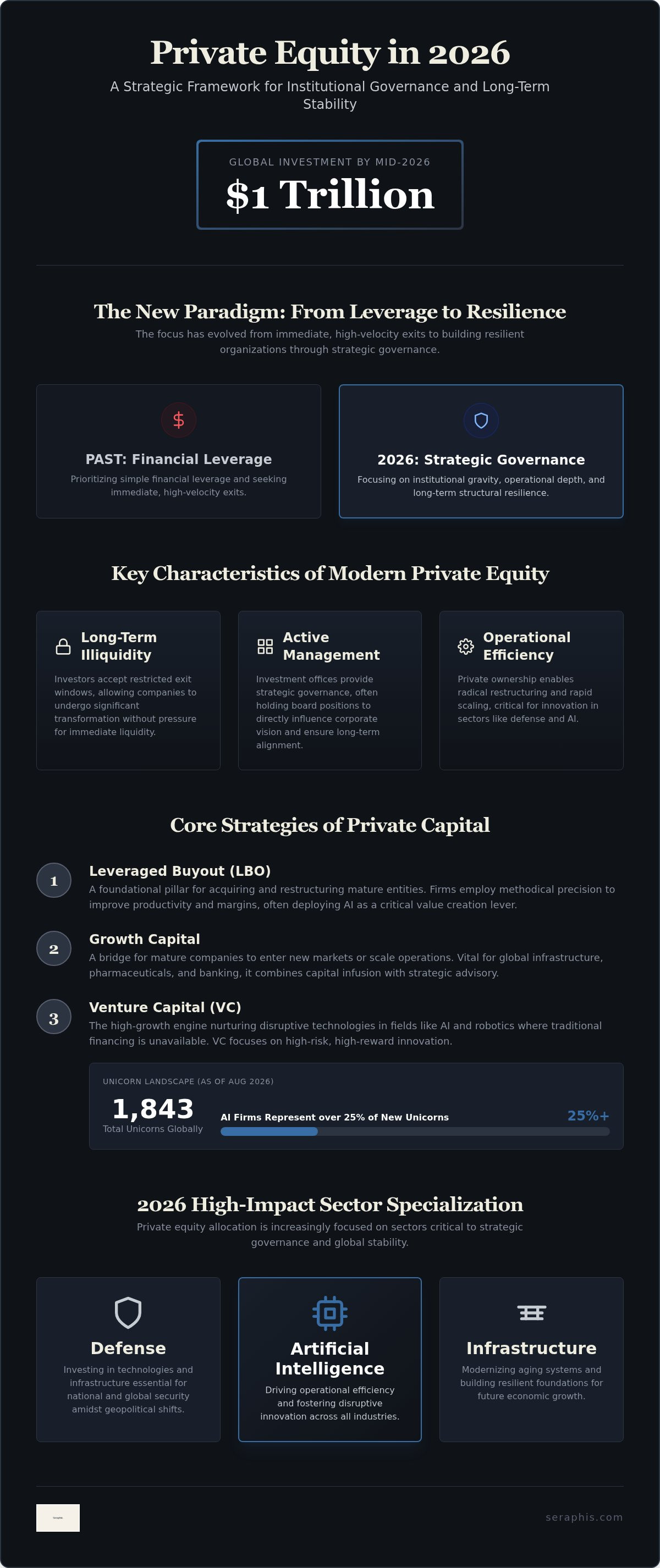
By mid-2026, global private equity investment reached $1 trillion, yet the most sophisticated investors recognize that the true value of these assets no longer resides in simple financial leverage. In an era defined by geopolitical shifts and rapid technological advancement, private equity has evolved into a critical mechanism for strategic governance and long-term stability. This shift reflects a move toward institutional gravity, where the focus is on building resilient organizations rather than seeking immediate, high-velocity exits.
It's understandable that many institutional partners feel a sense of caution when approaching these markets. The complexity of highly regulated sectors like aerospace and healthcare, combined with a historical lack of transparency in many investment models, often makes it difficult to align capital with genuine strategic goals. This article offers a comprehensive analysis of how structured oversight transforms private investments into engines for sustainable growth. We'll provide a clear framework for evaluating current opportunities and identify the high-impact sectors, such as AI and defense, that are set to lead the global market through 2026.
Defining Private Equity in the 2026 Global Economy
In its most fundamental sense, Defining Private Equity involves the acquisition of equity interest or ownership in companies that aren't traded on public exchanges. Unlike traditional asset classes that prioritize daily liquidity and passive participation, this asset class requires a commitment to long-term capital horizons. In 2026, the distinction between private markets and public equities has sharpened. Private structures allow for a level of operational depth and strategic alignment that's often unattainable within the quarterly reporting constraints of public markets. This characteristic makes private equity a preferred vehicle for institutional-grade portfolios seeking stability amidst broader market volatility.
The contemporary global economic environment necessitates a sophisticated synthesis of capital and specialized expertise. While traditional instruments like mutual funds might focus on broad market exposure, private equity provides a mechanism for deep, sector-specific intervention. This is particularly evident in high-impact fields where regulatory complexity and technological barriers are high. By decoupling from the immediate pressures of public sentiment, organizations can focus on foundational growth and structural resilience.
The Evolution of Private Capital
The landscape has moved beyond the leveraged buyout models of previous decades. Today, the focus is on strategic partnership and value creation. Global instability has reframed these investments as tools for institutional resilience. Private investment offices now play a central role in this shift. They act as stewards of capital, ensuring that investment timelines align with the actual growth cycles of industries like aerospace and robotics. This evolution reflects a broader "flight to quality" observed in early 2026, where investors prioritize high-conviction deals in transformative sectors over speculative, short-term gains.
Key Characteristics of Private Equity
- Long-term Illiquidity: Investors accept restricted exit windows in exchange for a complexity premium. This patience allows companies to undergo significant transformations without the need for immediate liquidity.
- Active Management: Investment offices don't just provide capital; they provide strategic governance. They often hold board positions and influence corporate vision directly to ensure alignment with long-term objectives.
- Operational Efficiency: Private ownership allows for radical restructuring or rapid scaling. This is critical in sectors like defense and AI, where the pace of innovation requires decisive, methodical action.
These characteristics define a disciplined approach to wealth preservation and growth. The ability to maintain a steady, organized pace of development is a hallmark of the modern strategic authority in the private markets.
Core Strategies of Private Capital: Beyond the Leveraged Buyout
The deployment of capital within Explainer: What Is Private Equity? has transitioned from singular transaction types to a diverse set of strategic frameworks. While the leveraged buyout (LBO) remains a foundational pillar for acquiring and restructuring mature entities for operational efficiency, it represents only one facet of the modern private equity ecosystem. Institutional portfolios now utilize a tiered approach, incorporating growth capital and mezzanine structures to address specific lifecycle needs. Mezzanine capital, acting as a hybrid of debt and equity, provides the necessary flexibility for targeted expansion projects without immediate equity dilution. It's a precise tool for organizations that require structured financing but are not yet ready for a full equity reset.
Active management remains the defining characteristic of these strategies. In the LBO model, firms employ methodical precision to improve productivity and margins, often deploying AI as a critical value creation lever. This rigorous oversight ensures that private equity investments follow a clear, structured path toward profitability. By mid-2026, this flight to quality has become a dominant trend as investors prioritize larger, high-conviction deals that offer stability in an uncertain macroeconomic environment.
Growth Capital and Strategic Expansion
Growth capital serves as a bridge for mature companies seeking to enter new markets or scale existing operations. In 2026, this strategy has become vital for global infrastructure projects, where massive liquidity is required to modernize aging systems. Within sectors like pharmaceuticals and banking, growth capital doesn't just provide funding; it brings a synergy of capital infusion and strategic advisory. This involvement ensures that organizational management aligns with international business standards and regulatory requirements. For those seeking deeper investment insights, understanding these structural nuances is essential for long-term planning.
The Strategic Role of Venture Capital
Venture capital functions as the high-growth engine of the private market. It's specifically designed to nurture disruptive technologies in fields like AI and robotics, where traditional debt financing is often unavailable. As of August 2026, there are 1,843 unicorn companies globally, with AI firms representing over 25% of new achievements in this category. This high-impact focus distinguishes venture capital from traditional PE strategies that prioritize stable cash flows. VC funding is a subset of private capital focused on high-risk, high-reward innovation. By providing the necessary capital for early-stage ventures, it allows for the rapid development of technologies that are essential to global stability and progress.
High-Impact Sector Specialisation: Defense, AI, and Infrastructure
In 2026, the allocation of private equity has increasingly gravitated toward sectors that underpin global stability and national security. The defense and aerospace industries have seen a resurgence in interest, driven by substantial government spending and a $961.6 billion U.S. Department of Defense budget for the fiscal year. Private capital serves as a stabilizing force in these environments. It provides the long-term horizons necessary for complex research and development cycles that public markets often find difficult to sustain. By mid-2026, global deal value in these sectors has remained robust, building on the $50.3 billion in transactions recorded in 2025.
Defense and Aerospace Investment
Strategic capital is no longer solely about financial returns; it's about ensuring technological sovereignty. In a multipolar world, the role of private capital for defense sector development is paramount for maintaining a competitive edge. This involves implementing rigorous strategic governance within aerospace innovation pipelines. Every stage of development, from initial prototype to deployment, is managed with methodical precision. By focusing on critical infrastructure resilience, private investors help shield vital systems from geopolitical shocks and supply chain disruptions.
Technological Infrastructure: AI and Robotics
The digital age requires a foundational infrastructure that is both robust and adaptable. AI and robotics are at the center of this modernization, particularly within legacy industrial systems that require structural updates. As of August 2026, AI continues to be a dominant growth engine. Of the 191 companies that achieved unicorn status in 2026, approximately 25.7% operate in the AI sector. Beyond software, the physical application of robotics is driving unprecedented efficiency in banking operations and healthcare delivery. Managing the ethical implications of these technologies requires the kind of private strategic oversight that prioritizes long-term societal alignment over immediate disruption.
Managing capital within healthcare and pharmaceuticals presents unique challenges due to the high degree of regulatory oversight. The implementation of AIFMD II, which required transposition into member-state law by April 16, 2026, has introduced new layers of transparency for fund managers. Success in these fields depends on the ability to navigate complex legal frameworks while sustaining investment in life-saving innovation. This disciplined approach ensures that private equity remains aligned with the rigorous standards of global health authorities and pharmaceutical boards.
Institutional Governance and Strategic Oversight Frameworks
Modern capital management requires more than just financial allocation. It demands a rigorous framework of institutional governance. In 2026, the transition toward transparency in private investment offices has become a necessity rather than an option. This shift is driven by both regulatory pressure and a sophisticated investor base that demands clarity. By implementing institutional-grade investment insights, firms can effectively mitigate cross-sector risks that often remain hidden in less structured models.
The Board of Directors in private equity-backed firms serves as the cornerstone of this oversight. Unlike public boards that may focus on quarterly optics, these boards are structured to ensure that every operational decision aligns with the long-term corporate vision. Ethical standards aren't merely compliance requirements; they're integrated into the capital management process, especially in critical sectors where public trust is vital. This principled approach ensures that private equity remains a stable force in the global economy, following a clear, structured path toward institutional maturity.
Risk Mitigation and Strategic Governance
Managing correlation in global portfolios requires a disciplined approach. Through strategic investment advisory, firms can develop frameworks that prioritize long-term value creation over short-term gains. This is particularly relevant as the NAIC Securities Valuation Office begins flagging credit ratings that don't reasonably reflect risk as of January 1, 2026. Transparency in governance ensures that stakeholders understand the logic behind each investment, fostering a culture of stability and intellectual rigor. It's about looking at the big picture and operating with a sense of duty and methodical precision.
Operational Excellence in Private Portfolios
Strategic oversight directly correlates with improved performance in complex fields. For instance, a robust healthcare investment strategy relies on institutional logic to navigate the intricacies of pharmaceutical development and medical infrastructure. Resilience is maintained through sophisticated capital management techniques that anticipate regulatory shifts, such as the AIFMD II implementation in April 2026. For organizations seeking to implement these rigorous standards, establishing a foundation of strategic governance is the first step toward enduring growth.
The Strategic Role of a Private Investment Office in PE Allocation
A private investment office functions as a specialized partner for institutional and private clients, providing a level of depth that retail brokerage models simply cannot replicate. While traditional platforms focus on broad market access, a private office prioritizes global investment strategies rooted in deep sector expertise. This approach is essential for navigating the complexities of high-impact fields where the intersection of technology and regulation creates significant barriers to entry. In 2026, the value of institutional-grade analysis has become particularly evident within the AI and pharmaceutical sectors, where the pace of innovation requires a methodical and patient capital approach.
The distinction between these specialized offices and retail services is fundamental. A private office doesn't engage in personal financial planning or retail-level transactions. Instead, it operates with the gravity of a seasoned strategist, looking at the big picture to ensure that capital is aligned with long-term philosophical goals. This methodical precision is what allows for the successful deployment of private equity in environments that demand high levels of transparency and intellectual rigor.
Specialized Capital Management
Sophisticated investors often prefer the structure of a private office because it offers a framework for managing complex investments in defense and robotics. Unlike the standardized offerings found in retail environments, these offices implement strategic governance that aligns capital with the specific operational needs of a portfolio company. This involves a rigorous assessment of technological sovereignty and infrastructure resilience. It's not just about capital deployment; it's about the intellectual rigor required to oversee projects with long-term horizons. By providing this specialized oversight, a private office ensures that investments remain stable even as geopolitical and macroeconomic conditions fluctuate.
The Path Forward for Private Equity
Preparing for the shifts in global capital markets through 2026 requires an unwavering commitment to institutional rigor. The implementation of updated IPEV valuation guidelines and the AIFMD II regulatory framework has set a new standard for transparency and accountability. Private equity allocation is no longer a matter of simple diversification; it's a strategic necessity for those operating in the upper tiers of the global economy. Seraphis Group provides the strategic insights and governance frameworks required to navigate this landscape. By focusing on high-growth sectors like aerospace and critical infrastructure, the group ensures that capital is not only preserved but actively utilized to drive global progress. Success in the coming years will belong to those who view investment as a disciplined exercise in long-term vision and methodical precision.
Strategizing for the Next Era of Global Capital
The landscape of private equity in 2026 is defined by a transition toward institutional rigor and sector-specific depth. Success in this environment requires more than capital; it demands a sophisticated framework for strategic governance and an unwavering focus on long-term value creation. By prioritizing high-impact sectors such as defense, aerospace, and AI, investors can align their portfolios with the fundamental drivers of global stability and technological progress.
Seraphis Group offers the specialized guidance necessary to navigate these complex fields. Through global investment strategy implementation and institutional-grade investment insights, the group helps partners manage the intricacies of highly regulated environments. This disciplined approach ensures that capital isn't merely deployed but actively managed to achieve sustainable resilience. Aligning long-term vision with methodical execution remains the most reliable path toward enduring growth in an evolving market. Explore strategic investment insights with Seraphis Group.
Frequently Asked Questions
What is the primary difference between private equity and venture capital?
The primary distinction lies in the maturity of the target entity and the structure of the investment. Private equity typically involves acquiring established companies to improve operational efficiency or restructure for growth. Venture capital, as a specialized subset, focuses on early-stage ventures with high growth potential but higher risk profiles. While traditional PE strategies prioritize stable cash flows, venture capital nurtures disruptive technologies in fields like AI and robotics to achieve high-reward innovation.
How does private equity governance differ from public market oversight?
Private governance allows for a level of operational depth and strategic alignment that's often unattainable in public markets. Public companies operate under the constant pressure of quarterly reporting and public sentiment, which can lead to short-term decision-making. In contrast, boards within private structures focus on foundational growth and structural resilience. This long-term capital horizon ensures that every operational decision aligns with a principled institutional vision rather than immediate market optics.
Why is private equity considered a strategic tool for the defense sector?
Private capital serves as a critical mechanism for ensuring technological sovereignty and national security. The defense sector requires massive liquidity for long-term research and development cycles, which the $961.6 billion U.S. DoD budget for 2026 reflects. Private investors provide the stability needed to sustain these innovation pipelines without the volatility of public exchanges. This strategic oversight helps shield vital infrastructure from geopolitical shocks while maintaining a competitive edge in a multipolar world.
Can institutional investors manage risk effectively within private equity portfolios?
Institutional investors manage risk by implementing sophisticated governance frameworks and institutional-grade investment insights. By utilizing strategic advisory services, portfolios can mitigate cross-sector risks and manage correlations effectively. This methodical approach is essential as regulatory standards, such as the NAIC reforms effective January 1, 2026, demand higher transparency. These frameworks allow for a disciplined analysis of investment risks, ensuring that capital remains resilient even during periods of global macroeconomic uncertainty.
What are the main strategies used by private equity firms in 2026?
In 2026, firms primarily utilize leveraged buyouts, growth capital, and mezzanine debt to achieve specific lifecycle objectives. Leveraged buyouts focus on acquiring and restructuring mature companies for maximum efficiency. Growth capital provides the liquidity necessary for market expansion, particularly in pharmaceuticals and banking. Mezzanine capital offers a hybrid of debt and equity for targeted projects. These private equity strategies increasingly incorporate AI as a value creation lever to improve margins and enhance productivity across the portfolio.
Is private equity suitable for long-term infrastructure investment?
Private capital is exceptionally well-suited for infrastructure due to the alignment of long-term horizons and the need for significant liquidity. Modernizing digital and physical systems requires patient capital that can withstand extended development periods. Private investment offices facilitate these projects by providing the strategic oversight necessary to navigate complex regulatory environments. This approach ensures that infrastructure investments contribute to global stability while delivering the stability required for institutional-grade portfolios.
How does a private investment office add value to private equity allocation?
A private investment office adds value by providing specialized guidance and deep sector expertise that retail brokerages don't offer. These offices act as global strategists, focusing on high-impact sectors like aerospace and robotics. They implement strategic governance frameworks that ensure capital allocation aligns with long-term philosophical goals. By avoiding the limitations of retail models, a private office offers the intellectual rigor and methodical precision required to manage complex, institutional-grade investments effectively.
What role does AI play in modern private equity strategic advisory?
Artificial intelligence serves both as a critical investment sector and a fundamental tool for strategic advisory. Firms deploy AI to enhance productivity, improve margins, and drive growth within portfolio companies. In an advisory capacity, AI facilitates the analysis of vast datasets to identify emerging trends and high-conviction deals. This technological integration allows for more precise capital management and ensures that strategic decisions are rooted in stable, data-driven insights rather than speculative market trends.