
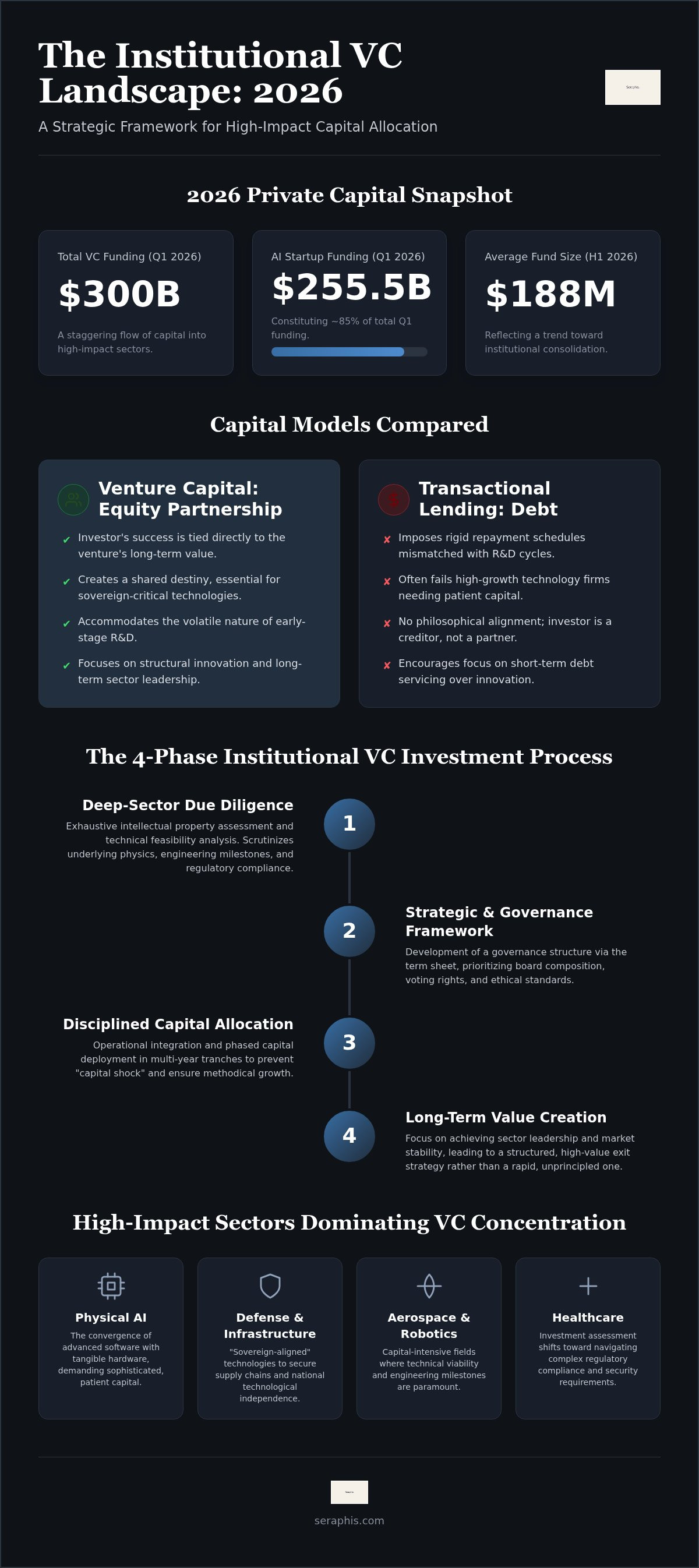
In the first quarter of 2026, VC funding reached a staggering $300 billion, with a significant concentration of capital flowing into high-impact sectors like AI and defense. While these figures suggest a robust market, the mere injection of liquidity is no longer sufficient to navigate the complexities of modern infrastructure development. For institutional investors and growth-stage ventures, the challenge has shifted from securing capital to establishing a framework of strategic governance and regulatory compliance that ensures long-term stability.
You likely recognize that capital fragmentation in emerging sectors like robotics often leads to a misalignment between immediate financial goals and the patient capital required for genuine innovation. This article explores how institutional-grade venture capital serves as a critical catalyst for progress through sector-specific expertise and rigorous oversight. We will examine the institutional logic behind successful capital allocation, identify the sectors currently holding the highest strategic potential, and define how to align governance structures with your long-term vision for growth.
The Evolution of VC Funding in 2026
The landscape of private capital has undergone a fundamental transformation, moving away from the speculative fervor of previous decades toward a model of rigorous, value-driven allocation. In the first half of 2026, the average fund size reached $188 million, reflecting a clear trend toward institutional consolidation and the professionalization of the asset class. Venture capital (VC) is no longer merely a source of liquidity; it's a mechanism for scaling complex systems that require both deep technical expertise and long-term patience. This shift is particularly evident in the rise of "Physical AI," where the convergence of advanced software and tangible hardware necessitates a more sophisticated approach to VC funding than the traditional "growth at all costs" software model.
A private investment office plays a pivotal role in this modern ecosystem by acting as a strategic steward. By integrating VC funding into a broader global investment strategy, these offices provide the stability required for ventures in robotics, aerospace, and defense. These sectors don't just need capital. They require a partner that understands the nuances of infrastructure development and the necessity of aligning technological milestones with institutional governance standards.
Venture Capital vs. Transactional Lending
The equity-based partnership model inherent in venture capital differs fundamentally from transactional lending. While debt-based solutions provide immediate capital, they often fail high-growth technology firms because they impose rigid repayment schedules that don't account for the volatile nature of early-stage R&D. Equity funding ensures that the investor's success is tied directly to the venture's long-term value. This creates a shared destiny between the founder and the funder. For companies developing sovereign-critical technologies, this philosophical alignment is essential to maintain the focus on structural innovation rather than short-term debt servicing.
The 2026 Macro Environment for Private Capital
Global interest rate stabilization has provided a predictable foundation for private capital, allowing valuations to surpass their 2021 peaks with greater intellectual rigor behind the numbers. We've seen a decisive shift toward "sovereign-aligned" technologies, specifically in defense and infrastructure, as nations seek to secure their supply chains and technological sovereignty. In 2026, VC funding acts as a strategic governance framework that synchronizes institutional capital with the operational requirements of sovereign-critical technologies. This environment rewards firms that prioritize transparency, risk management, and a methodical approach to capital deployment over those seeking rapid, unprincipled exits.
The Institutional VC Investment Process: A Strategic Framework
The transition from speculative capital to institutional-grade VC funding requires a methodical, four-phase approach designed to mitigate risk while maximizing structural impact. The Institutional VC Investment Process begins with deep-sector due diligence and an exhaustive intellectual property assessment. This is followed by the development of a strategic alignment and governance framework. The third phase involves disciplined capital allocation and operational integration, ultimately leading to a fourth phase focused on long-term value creation and a structured exit strategy. This sequence ensures that every dollar deployed is supported by a clear, logical path toward sector leadership.
Due Diligence in High-Impact Sectors
Evaluating technical feasibility in robotics and aerospace demands a level of expertise that transcends traditional financial analysis. Investors must scrutinize the underlying physics and engineering milestones of a project to ensure the technology is viable for commercial scale. In healthcare and defense, the assessment shifts toward regulatory compliance and sovereign security requirements. For example, as of January 1, 2026, SEC-registered advisers must implement formal AML compliance programs, including rigorous KYC protocols. Utilizing a strategic investment advisory framework allows for a more granular pre-investment analysis, ensuring that the venture’s operational reality matches its technical promise. This rigor is essential for maintaining institutional stability in volatile markets.
Structuring the Term Sheet for Governance
Strategic VC funding focuses on the long-term governance of the organization rather than just the immediate valuation. Modern term sheets prioritize board composition and voting rights to ensure that the venture remains aligned with its original mission. These agreements now frequently incorporate ethical AI and data privacy standards as non-negotiable clauses. This ensures that innovation doesn't outpace the ethical frameworks required by global stakeholders. To further protect the venture's trajectory, capital is often distributed in multi-year tranches. This approach prevents the "capital shock" often seen in early-stage funding and encourages a steady, methodical pace of development. Stability requires discipline. Governance isn't optional.
By establishing these rigorous standards early, ventures can build a foundation that attracts further institutional interest. For those seeking to refine their approach to capital management, exploring Investment Insights can provide the necessary clarity for complex decision-making.
High-Impact Sectors Dominating VC Concentration
In the current fiscal year, capital allocation has moved beyond broad-market diversification to target specific, high-impact pillars of the global economy. AI startups alone secured $255.5 billion in the first quarter of 2026, yet the true strategic value lies in the intersection of these digital models with physical infrastructure. This convergence defines the modern era of VC funding, where institutional investors prioritize ventures that offer tangible improvements to industrial and national security frameworks. The focus has shifted from ephemeral software solutions to the structural foundations of the global economy, including robotics, aerospace, and critical infrastructure.
Defense Technology and National Security
Private capital’s involvement in defense has transitioned from a niche interest to a central component of sovereign resilience. The rise of dual-use technologies allows ventures to serve both commercial markets and national security requirements, creating a dual-revenue stream that mitigates traditional aerospace risks. Utilizing private capital for defense ensures that autonomous systems and aerospace innovations receive the sustained support required for long-term deployment. This strategic capital allocation is fundamental to maintaining a technological edge in an increasingly fragmented global landscape. It's about more than profit; it's about securing the technological sovereignty of nations through methodical, principled investment.
The Future of AI and Robotics
The investment focus has shifted decisively from generative models toward "Physical AI" and agentic execution. While previous cycles prioritized content creation, 2026 is defined by AI that interacts with the physical world through advanced robotics and manufacturing automation. The shift from generative models to agentic, real-world execution represents a move toward functional autonomy. Investors are no longer satisfied with digital outputs; they seek systems capable of performing complex physical tasks in manufacturing and logistics. VC funding in this sector now requires a methodical assessment of how these systems integrate into existing industrial workflows without compromising operational integrity. This evolution presents unique governance challenges, particularly regarding the safety and ethical oversight of autonomous technology.
Healthcare and pharmaceuticals are also undergoing a transformation where digital resilience and AI-driven research are scaling innovation at unprecedented speeds. These investments focus on the long-term viability of global health systems, moving away from short-term pharmaceutical gains toward structural improvements in patient care and drug delivery. Similarly, critical infrastructure has emerged as a high-priority sector. Financing the backbone of the global economy requires a patient, institutional approach that aligns private capital with public necessity. This ensures that the essential systems of banking, energy, and transport remain robust in the face of evolving technological demands.
Strategic Governance: The Anchor of Venture Success
The deployment of capital in the absence of a robust governance framework frequently transforms a financial asset into a significant operational liability. In high-growth sectors where the pace of innovation often outstrips regulatory development, VC funding must be anchored by institutional standards to prevent the misallocation of resources. A Private Investment Office serves as a strategic steward, providing the rigorous guidance necessary to transition early-stage ventures into mature, stable organizations. This systematic oversight is particularly vital for mitigating cross-sector correlation risks. By applying a unified governance logic across disparate fields like aerospace and robotics, investors can ensure that volatility in one niche doesn't destabilize the broader portfolio. It's a matter of structural integrity rather than mere financial participation.
Institutional Logic in Board Representation
Professionalizing the board of directors represents a critical milestone in a venture's lifecycle, signaling readiness for future IPO or M&A activities. This transition requires a delicate balance between preserving the founder’s original vision and upholding the fiduciary responsibilities inherent in institutional partnerships. Governance frameworks prioritize the implementation of transparent reporting mechanisms and strict ethical standards. These structures don't just ensure compliance; they build the institutional gravity required to navigate complex global markets. A well-structured board acts as a strategic filter, ensuring that every operational decision aligns with the long-term objectives of the venture and its stakeholders. Stability is built through these deliberate, formal associations.
Managing Risk in Volatile Tech Sectors
Systematic governance provides the stability needed to navigate the geopolitical and regulatory shifts that define the current technological landscape. By adopting a methodical approach to capital management, ventures can maintain operational continuity during periods of market uncertainty. There's a notable synergy between a sophisticated healthcare investment strategy and technology oversight. Both disciplines require a profound understanding of regulatory hurdles and the ethical implications of data utilization. Integrating these perspectives allows for a more resilient investment posture, where risk is managed through foresight rather than reaction. This principled approach ensures that capital remains a tool for growth rather than a source of instability. VC funding works best when it's part of a broader, well-governed ecosystem.
Establishing these frameworks early is essential for any high-impact venture seeking to achieve global scale. For organizations looking to professionalize their investment approach, our Strategic Governance services offer the necessary institutional depth to secure long-term success.
Partnering for Growth: The Seraphis Group Perspective
Seraphis Group functions as a specialized investment partner for high-impact fields, offering a model of capital management that prioritizes structural stability over speculative gains. In an environment where VC funding is increasingly concentrated in megafunds, the group’s focus remains on the qualitative integration of capital into sectors like defense, AI, and critical infrastructure. This approach provides ventures with strategic insights that extend far beyond the initial deployment of funds. By aligning global investment strategies with the specific operational requirements of each sector, the group ensures that institutional gravity remains the foundation of every partnership. This commitment to long-term philosophical alignment is what distinguishes a private investment office from transactional funding sources.
Beyond Retail Brokerage: The Private Office Advantage
The distinction between a private investment office and retail brokerage services is fundamental to the Seraphis Group philosophy. Specialized capital management outperforms generic brokerage models by providing deep industry knowledge in complex areas such as robotics and aerospace. These sectors require an understanding of engineering lifecycles and sovereign security requirements that standard financial services simply don't possess. By acting as a strategic investment partner, the group provides access to global markets and institutional-grade Investment Insights that are unavailable through traditional retail channels. This ensures that high-growth ventures have the intellectual and financial support needed to scale within competitive international environments.
Next Steps for Strategic Capital Allocation
Engaging with a private investment office requires a methodical preparation process and a clear understanding of institutional partnership criteria. Ventures seeking to professionalize their capital structure must demonstrate a commitment to rigorous governance and transparent reporting standards. Preparing for a sophisticated capital management engagement involves more than just financial auditing; it requires the development of a long-term vision that accounts for regulatory shifts and technological evolution. Establishing this framework is the first step toward high-growth success. By focusing on these foundational principles, ventures can ensure they're prepared for the complexities of the 2026 investment landscape, where stability and VC funding oversight are the primary drivers of value.
Securing the Future of High-Impact Innovation
The transition toward institutional-grade capital in 2026 represents a critical evolution in how we finance the backbone of the global economy. It's clear that high-impact ventures require a framework where technical milestones and strategic governance are perfectly synchronized. By prioritizing sectors like defense and robotics, investors can ensure that innovation remains stable and aligned with sovereign interests. This methodical approach transforms capital from a simple resource into a powerful tool for structural change.
Seraphis Group acts as a specialized investment partner, bringing institutional gravity to the most complex technological frontiers. Our expertise in AI, robotics, and aerospace capital management allows us to serve as a global strategist for ventures that value long-term philosophical alignment. We don't just deploy resources; we help professionalize the path to global leadership. Establishing a disciplined approach to VC funding today ensures your organization is prepared for the structural demands of tomorrow's economy.
Explore Strategic Investment Insights from Seraphis Group. We look forward to supporting your vision with precision and clarity.
Frequently Asked Questions
What is the primary difference between VC funding and private equity?
The primary difference between venture capital and private equity lies in the stage of the business lifecycle and the risk profile of the investment. Venture capital targets early-stage startups with high growth potential, often in disruptive technology sectors. In contrast, private equity typically involves larger investments in established companies to facilitate restructuring or expansion. Both asset classes require rigorous oversight, but venture capital demands a more hands-on approach to strategic governance to navigate early-stage volatility.
How much equity do founders typically relinquish in institutional VC rounds?
In institutional rounds, founders typically relinquish a portion of their equity to investors based on the venture's valuation and the specific requirements for capital deployment. While the dilution of ownership is a primary consideration, the focus in professional VC funding environments is often on the quality of the partnership rather than the percentage alone. Securing an institutional-grade partner ensures that the remaining equity becomes part of a more stable, well-governed organization prepared for global scale.
What are the most critical sectors for VC funding in 2026?
As of 2026, the most critical sectors for capital concentration include Artificial Intelligence, robotics, defense, and aerospace. AI startups alone raised $255.5 billion in the first quarter of 2026, with a clear shift toward "Physical AI" and autonomous systems that support global infrastructure. These sectors attract institutional interest because they provide the technological foundation for national security and sovereign resilience. Investors prioritize these fields to ensure technological sovereignty in an increasingly complex global market.
How does strategic governance impact the valuation of a high-growth startup?
Strategic governance enhances a startup’s valuation by reducing operational risk and ensuring long-term institutional stability. When a venture implements professional board representation and transparent reporting standards, it signals maturity to future acquirers or public market investors. This framework is essential for navigating the updated 2026 SEC compliance requirements, such as formal AML programs. A well-governed organization often commands a premium valuation because it possesses the structural integrity required for sustained growth.
Can VC funding be used for defense and aerospace infrastructure projects?
Yes, VC funding is increasingly utilized to finance defense and aerospace infrastructure projects, particularly those involving dual-use technologies. These investments support the development of autonomous systems and satellite networks that serve both commercial and national security needs. By providing the patient capital required for hardware-intensive R&D, venture capital helps bridge the gap between initial prototyping and large-scale sovereign deployment. This strategic allocation is fundamental to maintaining technological sovereignty in the modern era.
What is the role of a private investment office in the venture capital process?
A private investment office acts as a specialized partner that provides strategic guidance and global investment insights beyond the simple deployment of capital. Unlike transactional lenders, these offices focus on the long-term philosophical alignment between the investor and the venture. They leverage deep industry expertise in sectors like pharmaceuticals and banking to optimize organizational management. This role is crucial for ensuring that high-growth ventures maintain institutional gravity while scaling their operations across diverse international markets.
How does institutional-grade due diligence differ from standard VC checks?
Institutional-grade due diligence is characterized by an exhaustive assessment of technical feasibility and regulatory compliance that far exceeds standard financial checks. This process involves a granular review of intellectual property and hardware engineering milestones. In 2026, this also includes mandatory risk assessments and suspicious activity reporting under updated FinCEN rules for investment advisers. This methodical approach ensures that every investment is supported by a clear, logical understanding of both the technology and the regulatory landscape.
What are the exit opportunities for high-impact ventures in 2026?
Exit opportunities for high-impact ventures in 2026 include traditional initial public offerings, strategic M&A, and secondary market transactions. As pre-money valuations have surpassed their 2021 peaks, the IPO window has reopened for companies that can demonstrate rigorous governance. Additionally, the rise of sovereign-aligned technologies has increased M&A activity from institutional entities seeking to secure critical infrastructure. These exits are most successful for ventures that have maintained a steady, methodical path toward institutional maturity.