
The distinction between speculative digital health ventures and essential healthcare infrastructure has reached a definitive tipping point. As an institutional stakeholder, you've likely observed how market volatility in the biotech sector and the increasing complexity of global regulations create a challenging environment for healthcare technology investments. It's difficult to distinguish between sustainable technological innovation and the speculative hype that often permeates the current market.
This article provides the foundational principles and strategic governance required to navigate high-impact assets with methodical precision. You'll discover a clear framework for evaluating opportunities that treats healthcare as a critical infrastructure sector rather than a mere subset of the technology industry. We'll explore the strategic alignment of AI and robotics with global institutional standards, offering a structured path for those seeking long-term resilience and growth in a rapidly evolving global market. By moving from a speculative mindset to a principled institutional framework, you can ensure your portfolio remains both stable and sophisticated as we approach 2026.
The Evolution of Healthcare Technology Investments in 2026
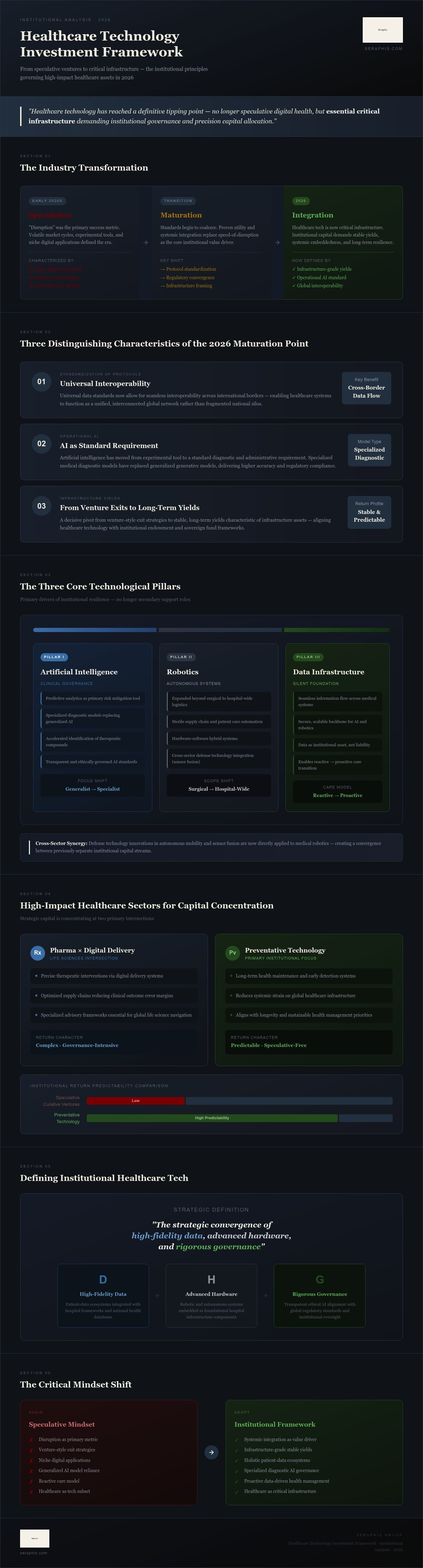
The landscape for healthcare technology investments has undergone a fundamental transformation, moving away from isolated digital applications toward a model of integrated institutional resilience. By 2026, the industry has transitioned beyond the experimental phase that characterized the early part of the decade. Investors now view these assets as critical infrastructure components, essential to the stability and functionality of global health systems. Private capital plays a decisive role in this environment, acting as the primary vehicle for bridging the gap between sophisticated clinical research and viable market applications. This period represents a maturation point where the focus shifts from rapid disruption to the preservation and expansion of systemic value. This evolution is driven by a necessity for operational efficiency and the realization that technological tools must be deeply embedded within the healthcare fabric to be truly effective.
From Disruption to Systemic Integration
It's clear that the speculative volatility that defined the early 2020s has been replaced by a demand for stability and proven utility. Unlike previous cycles where "disruption" was the primary metric for success, the current environment values systemic integration and long-term viability. Evaluating healthcare technology investments now requires a focus on holistic patient-data ecosystems that integrate seamlessly with existing hospital frameworks and national health databases. This shift ensures that technology serves the broader goals of institutional governance rather than merely offering niche improvements. Institutional Healthcare Tech is defined as the strategic convergence of high-fidelity data, advanced hardware, and rigorous governance.
Several factors distinguish the 2026 maturation point from previous speculative bubbles:
- Standardization of Protocols: Universal data standards now allow for interoperability across international borders.
- Operational AI: Artificial intelligence has moved from an experimental tool to a standard diagnostic and administrative requirement.
- Infrastructure Yields: A pivot from venture-style exit strategies to long-term, stable yields characteristic of infrastructure assets.
Identifying High-Impact Healthcare Sectors
Strategic capital is increasingly concentrated at the intersection of pharmaceuticals and digital delivery systems. This synergy allows for more precise therapeutic interventions and optimized supply chains, reducing the margin for error in clinical outcomes. Utilizing a specialized pharmaceutical investment advisory framework is essential for navigating these complex global life science markets. Additionally, preventative technology has emerged as a primary focus for institutional-grade capital. These systems prioritize long-term health maintenance and early detection, aligning with the broader institutional goal of reducing systemic strain on global healthcare infrastructure. The focus on preventative care reflects a strategic pivot toward longevity and sustainable health management, which offers more predictable returns than speculative curative ventures.
Core Pillars: AI, Robotics, and Data Infrastructure
The stability of 2026 healthcare technology investments relies on three distinct yet overlapping technological pillars. AI, robotics, and data infrastructure have moved beyond secondary support roles to become the primary drivers of institutional resilience. Significant cross-sector synergies are emerging, particularly where defense technology innovations in autonomous mobility and sensor fusion are applied to medical robotics. These advancements ensure that healthcare systems function with the precision and reliability expected of critical infrastructure. By integrating these disparate technologies, institutions can create a more cohesive and responsive medical environment.
Artificial Intelligence in Clinical Governance
Predictive analytics now serve as a primary tool for risk mitigation within institutional portfolios. The industry has largely moved away from generalized generative models in favor of specialized medical diagnostic models that offer higher accuracy and regulatory compliance. This precision is essential for the strategic oversight of AI-driven pharmaceutical research, where data-driven insights accelerate the identification of viable therapeutic compounds. By focusing on specialized governance, institutions ensure that AI applications remain transparent and ethically aligned with global standards. These models don't just process data; they provide the intellectual rigor necessary for complex clinical decision-making.
Robotics and Autonomous Medical Systems
Investment insights indicate a shift in robotics from purely surgical assistance to broader hospital management and logistics. Next-generation platforms now handle sterile supply chains and patient care tasks, reducing the burden on human staff and improving operational efficiency. Capital allocation is increasingly directed toward hardware-software hybrid systems that offer both physical capability and intelligent autonomy. These systems aren't speculative anymore. They're foundational to modern hospital infrastructure. For those seeking to refine their approach to these complex sectors, a private investment office provides the necessary strategic governance to evaluate these high-impact assets.
Robust data infrastructure remains the silent foundation of this technological shift. It's the essential layer that allows for the seamless flow of information between disparate medical systems and robotics platforms. Without a secure and scalable data backbone, the advantages of AI and autonomous systems can't be fully realized. This infrastructure ensures that data remains an asset rather than a liability, providing the stability required for long-term institutional growth. It's the framework that enables the transition from reactive care to proactive, data-driven health management.
Navigating Risk: Myth vs. Institutional Reality
The perception of high risk in the medical sector often stems from a fundamental misunderstanding of the industry's current maturity. While retail sentiment frequently fluctuates based on speculative hype, the institutional reality of healthcare technology investments in 2026 is grounded in predictable governance and structural necessity. Risk isn't merely an obstacle to be avoided; it's a variable that must be quantified through the lens of digital resilience and regulatory alignment. Portfolios that prioritize "safe" assets, those offering only incremental improvements to existing systems, often lack the institutional gravity required to capture the growth generated by systemic transformation. A successful strategy requires distinguishing between fleeting market trends and the foundational shifts that define critical infrastructure.
The Reality of Regulatory Compliance
Regulatory resilience has become a primary differentiator for successful healthcare assets. In 2026, global standards for medical data sovereignty require a sophisticated understanding of how information moves across jurisdictions. Strategic governance isn't just a compliance requirement; it's a proactive tool that prevents regulatory bottlenecks from devaluing an asset. International banking standards now increasingly influence healthcare capital, requiring that investment frameworks align with global transparency and ethical mandates. This alignment ensures that portfolios remain viable even as local laws shift. Organizations that fail to anticipate these regulatory movements find their capital trapped in non-compliant or obsolete frameworks.
Cybersecurity as a Healthcare Investment Metric
The evaluation of a technology firm's digital resilience is now as critical as its clinical efficacy. In high-stakes pharmaceutical environments, the cost of a single data breach can reach hundreds of millions of dollars in lost intellectual property and regulatory fines. Institutions must assess the cybersecurity posture of target firms with the same rigor applied to financial audits. Security-by-Design is an absolute prerequisite for any viable HealthTech architecture in the current market. By treating cybersecurity as a core investment metric, stakeholders can protect their capital from the catastrophic reputational and financial damage associated with infrastructure failure. This technical vetting process is essential for maintaining the long-term integrity of healthcare technology investments.
Ultimately, navigating the intersection of innovation and stability requires a rejection of speculative myths in favor of methodical analysis. Sophisticated assets are defined by their ability to withstand external shocks, whether they're regulatory shifts or digital threats. This structural integrity is what transforms a speculative venture into a cornerstone of an institutional portfolio. By focusing on these core realities, investors can move beyond the volatility of the biotech sector and secure a position in the future of global health infrastructure.
A Framework for Strategic Capital Allocation
Transitioning from the tactical nature of venture-style funding rounds to a comprehensive model of long-term capital management is a prerequisite for institutional success in 2026. This shift requires a deep understanding of how asset correlation functions across the healthcare and technology sectors. The volatility of standalone tech assets is often mitigated by the structural stability of healthcare infrastructure, creating a more resilient portfolio. Utilizing a healthcare investment strategy pillar ensures that capital allocation remains aligned with broader institutional objectives. It's about moving beyond the pursuit of the next "unicorn" and toward the construction of a durable, global infrastructure.
Governance Models for High-Growth Assets
Governance models for high-growth assets must prioritize institutional-grade reporting and absolute transparency. The Private Investment Office acts as a critical anchor in this process, providing management teams with the strategic oversight necessary to navigate global markets. This model moves beyond simple board participation to active guidance on regulatory and operational excellence. Strategic banking insights are also essential for healthcare infrastructure projects, ensuring that capital structures are optimized for long-term endurance. By implementing these standards, institutions can protect themselves against the mismanagement often found in less mature sectors.
Effective governance includes several key components:
- Regulatory Foresight: Anticipating shifts in global healthcare compliance before they impact asset value.
- Operational Audits: Regular assessments of a firm's technical and clinical delivery capabilities.
- Ethical Alignment: Ensuring that all technological applications meet international standards for patient safety and data usage.
Long-Term Value Creation Strategies
Long-term value creation relies on prioritizing patient-centric technological outcomes as a primary metric for success. These outcomes aren't just clinical goals; they're indicators of sustainable financial returns and market longevity. The role of private equity in scaling healthcare technology investments is vital, as it provides the necessary capital for complex hardware and software integration. Managing the lifecycle of these investments requires a patient, methodical approach that values stability over rapid exits. This strategy ensures that the asset remains a core component of the global health ecosystem for decades.
To explore how our team provides these specialized insights and guides complex capital management, visit our strategic governance office. We focus on providing the intellectual rigor necessary to identify and scale the most promising assets in the current global market.
Strategic capital allocation is ultimately a test of discipline. It requires the ability to ignore short-term market noise in favor of a structured, principle-based approach. By treating healthcare technology investments as a long-term commitment to global infrastructure, institutions can secure a position of strength in an increasingly complex economic landscape. This framework provides the stability required to navigate the challenges of 2026 and beyond.
Seraphis Group: Institutional Insights for Healthcare
Seraphis Group operates as a specialized private investment office, providing the intellectual rigor necessary to manage complex healthcare technology investments. Our approach is deliberate. We don't view medical innovation as a separate silo. Instead, it's an essential component of a stable global portfolio. By integrating insights from defense investments and aerospace into the medical field, we offer a unique perspective on the synergy between robotics, AI, and clinical application. This cross-sector expertise allows for a more comprehensive evaluation of high-impact assets that traditional firms might overlook. We focus on the big picture, ensuring that every asset aligns with the principles of strategic governance and long-term resilience.
The Global Strategist's Perspective
Sophisticated capital management requires more than just clinical understanding. It demands a methodology rooted in professionalism and methodical precision. Our group leverages deep industry knowledge to identify projects that offer long-term stability and institutional resilience. We prioritize the identification of assets that demonstrate not only clinical efficacy but also the structural integrity required to function as a pillar of global healthcare infrastructure. This perspective ensures that every decision is based on a thorough analysis of both technical capability and market durability. Our focus is clear. We value transparency and operate with a sense of duty toward our institutional partners.
Our methodology involves several distinct layers of analysis:
- Cross-Sector Technical Validation: Applying rigorous standards from defense and robotics to medical hardware.
- Infrastructure Alignment: Evaluating how technology integrates with national and international health systems.
- Governance Auditing: Ensuring that management teams adhere to institutional-grade reporting and ethical standards.
Partnering for Strategic Growth
Accessing institutional-grade advisory is paramount for those seeking to scale within the 2026 market. We provide strategic investment advisory that focuses on structural alignment and philosophical transparency. As a private investment office, we strictly avoid retail brokerage services. This ensures that our insights remain objective and focused solely on the needs of professional stakeholders. It's a model that provides a superior vehicle for managing the complexities of pharmaceuticals and medical technology. Partners seeking to refine their healthcare technology investments can rely on our established frameworks to achieve strategic alignment with global standards. We invite institutional partners to engage with our team to explore how these strategic insights can protect and grow their capital in an increasingly complex economic environment. This structured path ensures that your portfolio remains a stable entity in a world of rapid technological change.
Securing Institutional Resilience in the 2026 Healthcare Landscape
The maturation of the medical sector into a critical infrastructure pillar demands a shift from speculative participation to principled institutional governance. By treating healthcare technology investments as long-term assets rooted in AI, robotics, and robust data systems, organizations can achieve the stability required to withstand global market volatility. Success in this environment is no longer defined by rapid disruption but by the seamless integration of innovation within established regulatory and ethical frameworks. It's this strategic alignment that ensures capital remains protected while contributing to the expansion of global health capacity.
Seraphis Group provides the intellectual rigor and cross-sector expertise necessary to navigate these high-impact fields. As a private investment office, we offer specialized insights into AI and robotics, supported by strategic governance frameworks tailored for the global market. We invite you to access our institutional healthcare investment insights at Seraphis Group to explore how our methodical approach can refine your capital management strategy. Establishing a position of strength in 2026 begins with a commitment to clarity, precision, and a vision for the future of global health infrastructure.
Frequently Asked Questions
What are the primary drivers of healthcare technology investments in 2026?
The primary drivers include the integration of artificial intelligence into clinical diagnostics and the transition of healthcare into a critical infrastructure sector. Institutions now prioritize assets that offer systemic resilience and long-term stability rather than speculative disruption. The demand for universal data standards and interoperability across global health systems further accelerates this movement. These factors ensure that capital allocation remains aligned with the necessity for operational efficiency and improved patient outcomes.
How does AI impact the valuation of healthcare technology firms?
AI impacts valuation by shifting focus from generalized generative models to specialized medical diagnostic platforms that offer high accuracy and regulatory compliance. Firms demonstrating specialized medical AI capabilities often command higher institutional valuations due to their role in risk mitigation and clinical precision. Investors prioritize organizations that integrate AI-driven research within a framework of strategic governance. This technical maturity transforms AI from a speculative feature into a foundational driver of asset value.
Is healthcare technology considered a defensive or growth sector in 2026?
Healthcare technology is increasingly viewed as a hybrid sector that combines the stable yields of defensive infrastructure with the expansion potential of a growth sector. By 2026, healthcare technology investments are treated as essential pillars of global resilience, offering protection against economic volatility. The sector's growth is driven by the scaling of robotics and AI, while its defensive nature is secured by the fundamental necessity of healthcare services in any market environment.
What role does robotics play in modern healthcare capital allocation?
Robotics has transitioned from a niche surgical aid to a primary component of hospital management and logistics. Capital allocation is now directed toward hardware-software hybrid systems that manage sterile supply chains and autonomous patient care tasks. This shift reduces the operational burden on medical staff and improves systemic efficiency. Institutions value robotics platforms that demonstrate cross-sector technical validation, particularly those incorporating autonomous mobility and sensor technology originally developed for the defense sector.
How do global regulations affect healthcare technology investment strategies?
Global regulations serve as a primary filter for identifying viable institutional assets. Regulatory frameworks in 2026 emphasize medical data sovereignty and international banking standards, requiring that investment strategies account for cross-jurisdictional compliance. Strategic governance is essential to prevent regulatory bottlenecks that could devalue an asset. Portfolios that anticipate these legal shifts can secure a competitive advantage by ensuring their technological applications remain compliant with evolving transparency and ethical mandates worldwide.
What is the difference between retail healthcare funds and private investment office insights?
Retail healthcare funds often focus on broad market trends and publicly traded entities, which can be subject to high volatility and speculative sentiment. In contrast, a private investment office provides specialized insights into high-impact, private assets like advanced robotics and pharmaceutical research. These insights prioritize long-term capital management and strategic governance over short-term retail returns. This institutional approach avoids retail brokerage models to focus on the structural integrity and philosophical alignment of complex assets.
How can investors manage the risk of technological obsolescence in healthcare?
Managing obsolescence requires a focus on modular data infrastructure and scalable software-hardware hybrids. Investors should prioritize technologies that utilize universal protocols, allowing them to integrate with future advancements rather than becoming isolated legacy systems. Evaluating a firm's commitment to Security-by-Design and its ability to adapt to new clinical standards is also critical. A methodical vetting process ensures that healthcare technology investments remain relevant as global medical requirements and technological capabilities continue to evolve.
Why is strategic governance critical for healthcare technology portfolios?
Strategic governance provides the oversight necessary to align complex technological assets with institutional standards of transparency and reporting. It's the framework that ensures management teams prioritize long-term stability and ethical compliance over speculative growth. Without rigorous governance, portfolios are more vulnerable to regulatory failures, data breaches, and operational mismanagement. By implementing institutional-grade oversight, stakeholders can protect their capital and ensure that their healthcare technology investments function as resilient components of global infrastructure.