
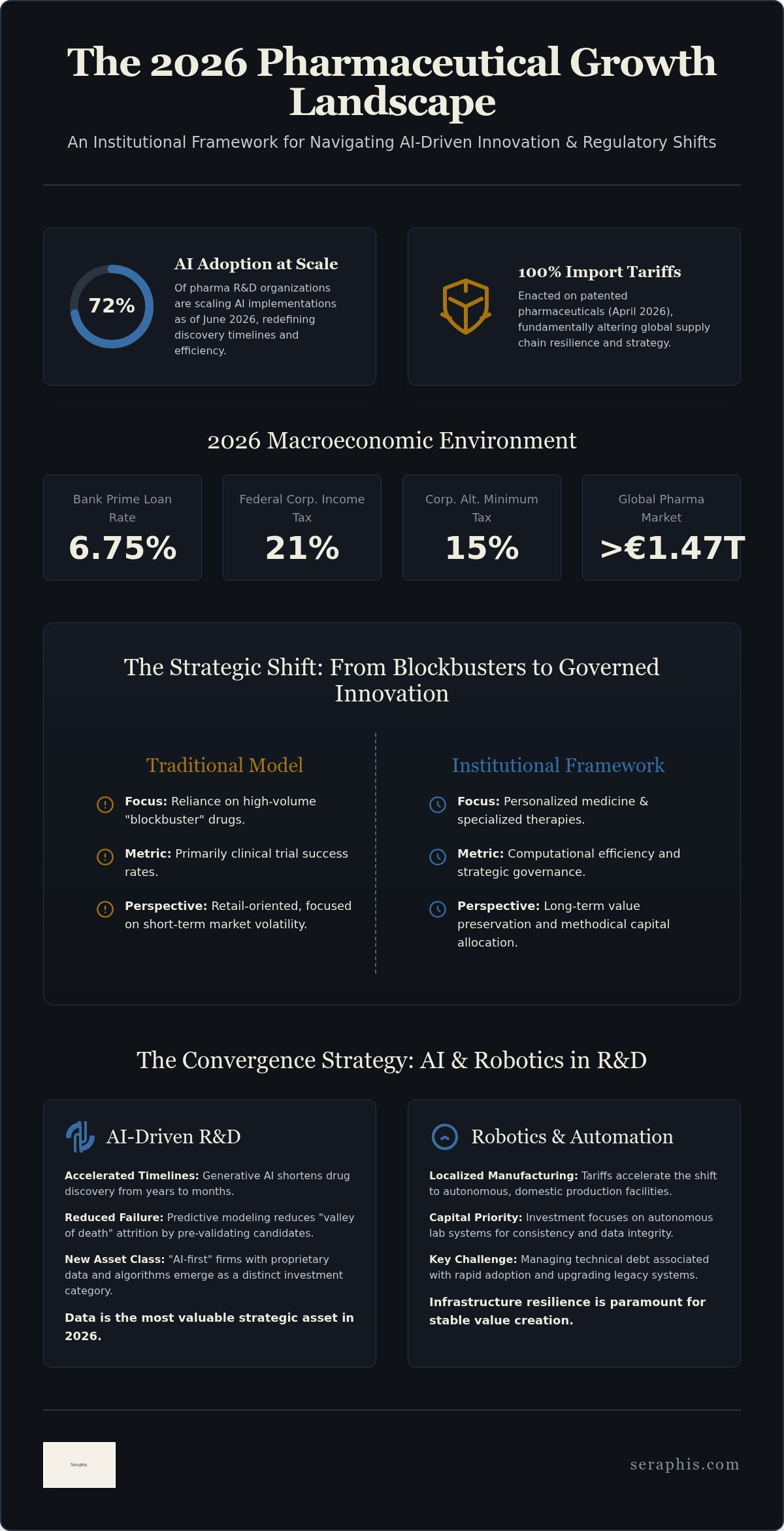
As of June 2026, 72% of pharmaceutical R&D experts report that their organizations have either fully scaled or are currently scaling AI implementations. This rapid technological shift, coupled with the 100% tariffs on imported patented pharmaceuticals enacted on April 2, 2026, has fundamentally altered the risk profile of the global sector. You're likely aware that traditional clinical trial success is no longer a sufficient metric for long-term value preservation. The inherent volatility of clinical outcomes and the technical complexity of integrating robotics into drug discovery require a more sophisticated approach to pharmaceutical growth investments. This article provides an institutional-grade framework for identifying and governing high-impact opportunities within this technology-driven market. We'll examine how to establish a systematic capital allocation strategy that identifies the strategic synergy between life sciences and emerging technology. By focusing on rigorous governance and methodical precision, we'll outline a path toward stable value creation in an era of regulatory uncertainty and rapid innovation. This perspective moves beyond the pursuit of blockbuster drugs to prioritize a structured, global investment strategy.
The 2026 Pharmaceutical Growth Landscape: An Institutional Overview
In 2026, pharmaceutical growth investments represent more than simple equity exposure; they are defined as long-term strategic capital allocations directed toward clinical innovation and the underlying infrastructure of the life sciences sector. The industry is currently undergoing a significant transition as the traditional reliance on "blockbuster" drugs diminishes. This shift favors personalized medicine and specialized therapies that address specific genetic profiles and rare diseases. Such a transition requires a fundamental re-evaluation of how capital is deployed across the drug development lifecycle. The Pharmaceutical Industry: An Overview provides a useful foundation for understanding these complex R&D processes and the evolving market dynamics that characterize this period.
Macroeconomic factors in 2026 have introduced new variables into the liquidity equation. With the Bank Prime Loan rate at 6.75% and a federal corporate income tax rate of 21%, the cost of capital necessitates a more disciplined approach to asset management. Institutional-grade management distinguishes itself from speculative biotech trading by prioritizing stability and long-term value preservation over short-term market volatility. This methodical approach is essential for navigating a landscape where the global pharmaceutical industry is valued at over €1.47 trillion, yet remains sensitive to shifting fiscal policies.
Structural Drivers of Life Science Growth
The demand for chronic disease management continues to escalate, driven by global demographic shifts and an aging population. This sustained demand provides a baseline of stability for the sector. Simultaneously, the focus on critical infrastructure has intensified. Following the 100% tariffs on imported patented pharmaceuticals announced in April 2026, the resilience of global supply chains has become a primary concern for strategic investors. Consequently, institutional capital is increasingly shifting toward earlier-stage clinical milestones where AI-driven discovery can be properly governed and integrated. This allows for the capture of value before traditional market entry, providing a buffer against the pricing pressures of the late-stage market.
The Institutional vs. Retail Perspective
A private investment office approaches the sector with a focus on strategic governance, ensuring that every allocation aligns with a broader philosophical framework. Unlike retail perspectives that may focus on immediate pricing trends, institutional leaders utilize Strategic Investment Advisory: Institutional Frameworks for 2026 to navigate fragmented regulatory environments. Global investment strategies are essential for managing the complexities of 2026, including the 15% Corporate Alternative Minimum Tax and new FDA registration requirements for distributed manufacturing. This methodical approach ensures that pharmaceutical growth investments remain resilient against clinical and regulatory headwinds through a focus on transparency and intellectual rigor.
Convergence Strategy: Integrating AI and Robotics in Pharma R&D
The convergence of artificial intelligence and advanced robotics has redefined the criteria for pharmaceutical growth investments in 2026. Institutional investors now evaluate clinical pipelines through the lens of computational efficiency rather than purely biological potential. Generative AI has drastically shortened discovery timelines, enabling firms to identify viable candidates in months rather than years. This acceleration is reflected in the FDA New Drug Approval Trends, which demonstrate an increasing volume of first-in-class therapies reaching the clinic. Understanding these shifts requires deep cross-sector expertise, particularly when structuring healthcare technology investments that bridge the gap between traditional medicine and high-performance computing.
An "AI-first" pharmaceutical company has emerged as a distinct asset class, characterized by its reliance on silicon-based discovery before any physical bench work begins. These organizations don't just use technology as a tool; they build their entire business model around algorithmic proprietary advantages. This model allows for a more predictable deployment of capital, as the probability of technical success is often higher when candidates are pre-validated through complex simulations. This methodical approach to drug development provides a level of transparency that's historically been absent from the biotech sector.
AI-Driven R&D: Efficiency and ROI
Predictive modeling serves as a vital tool for reducing the "valley of death," where many promising compounds fail during early-phase trials. By simulating drug-to-target interactions before physical testing begins, organizations can allocate capital with greater precision. Data has become the most valuable strategic asset in this environment. AI-integrated R&D serves as the primary differentiator for pharmaceutical valuation in 2026. Firms that maintain proprietary datasets and robust algorithmic frameworks are better positioned to sustain long-term growth. To explore how these frameworks apply to your portfolio, consider reviewing our strategic governance insights.
Robotics and Autonomous Infrastructure
Robotics and autonomous infrastructure represent the physical manifestation of this technological shift. The 100% tariffs on imported patented pharmaceuticals introduced in early 2026 have accelerated the move toward localized, automated manufacturing. Strategic capital allocation now prioritizes autonomous laboratory systems that function with minimal human intervention, ensuring consistency and data integrity. While the promise of automation is significant, institutional leaders must also manage the technical debt associated with rapid adoption. Upgrading legacy systems to support high-throughput robotics requires a methodical approach to ensure that short-term efficiency gains don't compromise long-term operational stability.
Comparative Analysis: High-Impact Pharmaceutical Segments
Identifying optimal sub-sector exposure requires a methodical evaluation of risk-return profiles across diverse therapeutic areas. Pharmaceutical growth investments in 2026 aren't monolithic; they demand a granular understanding of clinical pipelines and regulatory moats. While some segments offer stable profiles, others represent high-impact frontier opportunities that require specialized pharmaceutical investment advisory to navigate. This selection process is further complicated by the correlation between global defense needs and pharmaceutical resilience. Biodefense, for example, has become a critical component of national infrastructure, ensuring that companies involved in medical countermeasures maintain a degree of insulation from standard market fluctuations.
Strategic capital allocation in this environment prioritizes segments where clinical success is matched by commercial durability. We don't view the market as a collection of isolated bets, but as a complex ecosystem where regulatory shifts and geopolitical trends influence asset valuation. The current landscape favors firms that demonstrate intellectual rigor in their R&D processes, particularly those that can articulate a clear path toward long-term value preservation in an era of heightened fiscal scrutiny.
Oncology and Immunology: The Core of Growth
Cell and gene therapies have evolved from experimental concepts into institutional-grade assets. These modalities represent a shift away from chronic management toward curative intent, fundamentally altering the long-term value proposition of the companies developing them. In the monoclonal antibody space, strategic positioning is essential. While major oncology indications face increasing market saturation, unmet medical needs in specialized immunology continue to offer robust entry points. Investors must distinguish between crowded therapeutic classes and those where novel mechanisms of action offer a clear competitive advantage. The focus remains on identifying companies that can sustain high-margin profiles despite the 15% Corporate Alternative Minimum Tax currently in effect for large-scale entities.
Neurology and Rare Diseases: High-Risk, High-Impact
The neurology segment currently presents significant breakthrough potential, particularly regarding neurodegenerative disease treatments. Success in these areas provides a substantial first-mover advantage in niche markets that have historically lacked effective interventions. Rare diseases offer a different but equally compelling profile. Orphan drug designations serve as a protective moat for capital, as they come with extended market exclusivity and a 25% tax credit for qualified clinical testing expenses in 2026. This regulatory environment creates a structured path for value preservation, even in high-risk clinical environments. Beginning in the 2026 tax year, the IRS requires more detailed reporting on Form 6765 for R&D tax credits, which benefits firms with rigorous internal governance and transparent accounting practices. By focusing on indications with clear regulatory pathways, institutional offices can manage the inherent volatility of the life sciences sector.
Strategic Governance and Risk Mitigation Framework
Successful capital allocation in the life sciences sector is contingent upon a disciplined oversight framework that transcends simple financial metrics. For institutional investors, pharmaceutical growth investments must be governed by a methodical process that accounts for both clinical volatility and regulatory complexity. This approach ensures that capital isn't merely deployed but is actively managed to preserve value across long-term horizons. A robust healthcare investment strategy prioritizes this structural stability, aligning financial objectives with the rigorous demands of institutional compliance and ethical standards.
The Seraphis Governance Model
We utilize a specialized five-step governance process to evaluate and oversee every opportunity within the pharmaceutical sector. This system provides a structured path for identifying value while minimizing exposure to avoidable operational failures. The process includes:
- Step 1: Deep technical due diligence on R&D platforms. We verify the underlying computational and biological frameworks to ensure they're sound and scalable.
- Step 2: Regulatory pathway mapping across multiple jurisdictions. This accounts for the fragmented global landscape and the 2026 FDA registration requirements for foreign establishments.
- Step 3: Intellectual property resilience assessment. We analyze the strength of the asset's protective moat against emerging generic competition and patent expirations.
- Step 4: Strategic alignment with global healthcare infrastructure. This ensures the pharmaceutical solution fits within existing or emerging delivery systems and supply chains.
- Step 5: Ethical and compliance auditing. We maintain the high-level corporate register required for international business standards and institutional-grade portfolios.
Mitigating Clinical and Market Risks
Clinical trial failure is an inherent reality of the life sciences, yet its impact can be mitigated through diversified strategic capital allocation. We balance the high volatility of pharmaceutical outcomes by analyzing cross-sector correlations, specifically between technology and defense. This hedging strategy provides a necessary buffer against the binary outcomes of individual drug candidates. In private equity models, transparent governance is the primary tool for maintaining institutional confidence during extended development cycles. Strategic governance serves as the bridge between scientific innovation and institutional stability. To refine your firm's approach to risk management, explore our Strategic Governance insights.
Seraphis Group: A Specialized Partner in Pharmaceutical Capital
Seraphis Group serves as a private investment office, providing the intellectual rigor and strategic guidance required for institutional-grade life science insights. We don't operate as a retail brokerage. Our firm offers a composed, strategic authority for stakeholders who need to manage complex cross-sector correlations between healthcare, defense, and technology. Our approach to pharmaceutical growth investments is built on a foundation of global investment strategy. This ensures that capital is positioned to withstand the shifting regulatory and fiscal pressures of 2026. We navigate the 15% Corporate Alternative Minimum Tax and the logistical complexities of the 100% pharmaceutical tariffs with methodical precision and a focus on long-term value preservation.
Institutional Rigor for Private Capital
The private investment office model offers significant advantages over traditional brokerage structures by prioritizing philosophical alignment and rigorous strategic governance. This model allows for a level of transparency and stability that's essential when managing high-impact assets. Institutional partners gain access to specialized insights in private equity and healthcare assets that are often overlooked by broader market participants. We naturally integrate our expertise in AI and robotics into our pharmaceutical advisory. We recognize that these technologies are now fundamental to R&D valuation and clinical success. By maintaining this multidisciplinary perspective, we ensure that every allocation is supported by deep technical due diligence. This includes monitoring the detailed R&D tax credit reporting requirements introduced in the 2026 tax year to ensure full compliance and maximized returns.
Conclusion: Securing Long-Term Growth
The future of pharmaceutical growth is a multidisciplinary endeavor. It requires a synthesis of biology, high-performance computation, and global strategy. As we navigate the remainder of 2026, the ability to govern these complex intersections will distinguish successful portfolios from speculative ones. We invite institutional partners to explore our strategic governance frameworks. These frameworks are designed to preserve value and ensure transparency in a market characterized by both immense potential and significant volatility. Our commitment to stability remains the cornerstone of our approach to capital management. We focus on clear definitions of intent and a patient, thorough rhythm of operations. Explore our Investment Insights for professional capital management and a sophisticated perspective on the global pharmaceutical landscape.
Strategic Resilience in the 2026 Life Science Market
The evolution of the pharmaceutical sector in 2026 demands a departure from speculative models toward a framework rooted in intellectual rigor. Integrating artificial intelligence and robotics into the R&D lifecycle allows organizations to achieve a level of predictive precision previously unavailable to institutional capital. Successfully navigating the current tariff environment and shifting regulatory requirements requires a global investment strategy that prioritizes long-term value preservation over temporary market fluctuations. It's essential to recognize that clinical success is now inextricably linked to technological proficiency and sophisticated governance.
Seraphis Group provides the specialized expertise necessary to manage these complex cross-sector correlations between healthcare and technology. Our institutional-grade governance frameworks and global market reach offer the stability required for sophisticated pharmaceutical growth investments. We invite you to Request Institutional Investment Insights from Seraphis Group to explore how our cross-sector strategic advisory can support your capital allocation objectives. We look forward to establishing a principled partnership built on transparency and methodical precision.
Frequently Asked Questions
What are the primary drivers of pharmaceutical growth investments in 2026?
The primary drivers of pharmaceutical growth investments in 2026 include the rapid adoption of AI-driven R&D and a strategic shift toward personalized medicine. Additionally, the 100% tariffs on imported patented pharmaceuticals introduced in April 2026 have focused attention on localized manufacturing infrastructure. These factors, combined with the 15% Corporate Alternative Minimum Tax, necessitate a disciplined approach to capital allocation that prioritizes high-impact therapeutic segments and resilient global supply chain frameworks.
How does AI impact the valuation of pharmaceutical companies?
AI significantly enhances valuation by reducing drug discovery timelines and improving the probability of technical success. In 2026, companies that have successfully scaled AI implementation are valued as a distinct asset class due to their computational efficiency. This "AI-first" approach allows for more predictable capital deployment. By simulating drug-to-target interactions before physical trials, these firms minimize the "valley of death" risks, leading to higher institutional confidence and more robust long-term value preservation.
Is private equity a suitable vehicle for pharmaceutical growth capital?
Private equity serves as a robust vehicle for pharmaceutical capital, particularly for assets requiring extended development cycles and rigorous strategic governance. Unlike public markets, private equity allows for a methodical, long-term perspective that aligns with the complexities of clinical milestones. This structure is ideal for managing the high-impact therapeutic areas of 2026, such as immunology and oncology, where patient capital and specialized institutional oversight are required to navigate clinical volatility and regulatory hurdles.
What role does strategic governance play in life science investments?
Strategic governance acts as the essential bridge between scientific innovation and institutional stability. It provides a structured framework for evaluating R&D platforms, mapping regulatory pathways, and assessing intellectual property resilience. In a technology-driven market, governance ensures that AI and robotics integration follows ethical standards and global compliance requirements. This methodical oversight preserves value by ensuring that investment decisions are based on intellectual rigor rather than speculative market trends or short-term volatility.
How should a private investment office manage clinical trial risks?
A private investment office manages clinical trial risks through a combination of deep technical due diligence and cross-sector hedging. By analyzing correlations between pharmaceuticals, technology, and defense, offices can balance the binary outcomes of individual trials. This diversified approach ensures that a single clinical failure doesn't compromise the entire portfolio. Strategic capital allocation is directed toward indications with clear regulatory moats, such as orphan drugs, which provide a degree of insulation from broader market pressures.
What is the difference between pharmaceutical investment advisory and retail brokerage?
Pharmaceutical investment advisory focuses on providing specialized insights and strategic guidance for institutional-grade assets, whereas retail brokerage typically offers simple equity exposure without deep sector analysis. Seraphis Group explicitly avoids retail services, prioritizing the global investment strategy and philosophical alignment required by private offices. Advisory services involve rigorous technical due diligence and a focus on long-term capital management, ensuring that stakeholders understand the complex interplay between clinical success, technology, and global regulatory environments.
How do robotics and automation influence pharmaceutical manufacturing investments?
Robotics and automation influence manufacturing investments by increasing consistency and enabling localized production in response to 2026 trade policies. Automated laboratory systems reduce human error and enhance data integrity, which are critical for meeting modernized FDA registration requirements. Strategic capital is increasingly allocated toward autonomous infrastructure that can scale efficiently while managing technical debt. These technologies allow firms to maintain high-margin profiles despite rising capital costs and the global shift toward distributed manufacturing models.
What are the most promising pharmaceutical sub-sectors for 2026?
The most promising sub-sectors for 2026 include oncology, immunology, and rare diseases, alongside high-demand areas like obesity and Type 2 diabetes treatments. Oncology remains a core growth area as gene therapies evolve into institutional-grade assets. Rare diseases are particularly attractive because orphan drug designations provide a 25% tax credit for clinical testing and extended market exclusivity. These segments offer a structured path for value preservation through clear regulatory pathways and significant unmet medical needs.