
The traditional metrics of healthcare investment have undergone a fundamental shift due to the convergence of advanced robotics and significant regulatory adjustments. Effective healthcare sector capital allocation in 2026 demands a departure from historical volume-based models in favor of a framework centered on institutional resilience and systematic technological integration. With benchmark premiums on the Affordable Care Act Marketplace projected to increase by an average of 21.7 percent, the margin for strategic error has reached a critical threshold.
You likely recognize that the integration of artificial intelligence and early-stage life sciences has introduced a level of valuation complexity where traditional appraisal models don't always suffice. This discussion offers the sophisticated logic required to master capital allocation within this evolving landscape, ensuring that your portfolio remains both protected and performant. We will establish a clear framework for sub-sector prioritization, analyze the role of strategic governance in capital protection, and define the necessary alignment with contemporary global investment strategies.
The Evolution of Healthcare Capital Allocation in 2026
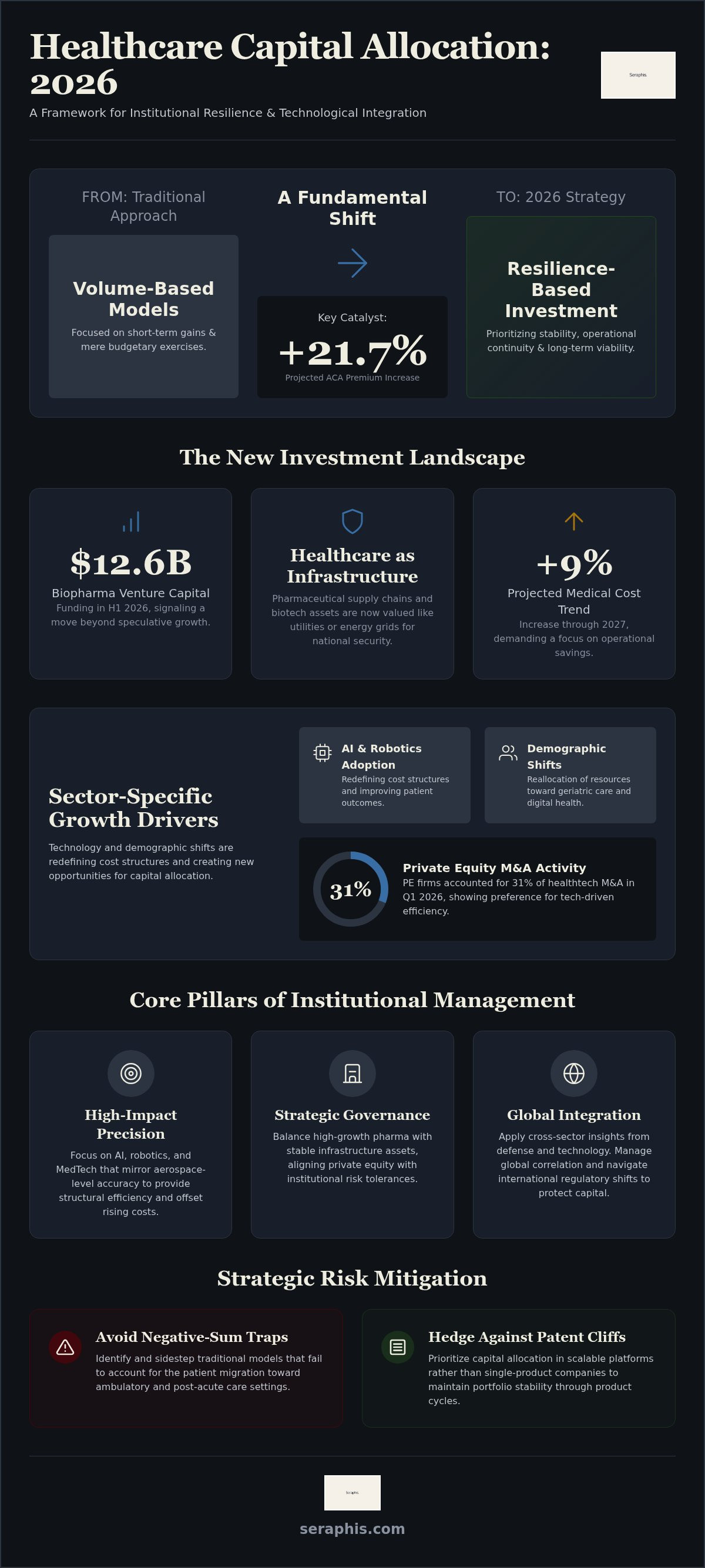
Healthcare capital allocation is the systematic distribution of financial resources to optimize long-term health outcomes and institutional returns. By 2026, this process has matured into a sophisticated governance tool rather than a mere budgetary exercise. The transition from volume-based models to resilience-based investment reflects a global recognition that healthcare systems must withstand external shocks. Institutional stakeholders now prioritize assets that offer stability amidst the 21.7 percent increase in benchmark premiums on the Affordable Care Act Marketplace. This shift requires a rigorous assessment of how healthcare sector capital allocation can support both operational continuity and strategic growth in an increasingly volatile environment.
This year represents a definitive turning point for institutional involvement in life sciences. With biopharma venture capital funding reaching $12.6 billion in the first half of 2026, the sector has moved beyond speculative growth. The current environment demands a methodical approach to capital deployment that balances high-impact innovation with the necessity of capital preservation. Decisions are no longer driven by short-term gains but by the long-term viability of the underlying healthcare assets.
Healthcare as Critical Infrastructure
Strategic planners now view healthcare through the lens of national security and critical infrastructure. The stability of pharmaceutical supply chains has become a primary concern for private capital, leading to a shift in how biotech assets are valued. Instead of treating these as high-risk speculative bets, institutional logic increasingly categorizes them alongside utilities or energy grids. This perspective is vital when navigating the complexities of the U.S. Healthcare Finance System, where the convergence of public health needs and private investment stability dictates long-term viability. By treating biotechnology and pharmaceutical production as essential infrastructure, investors can apply more rigorous governance frameworks to protect against supply chain vulnerabilities and ensure the continuous delivery of care.
Drivers of Sector-Specific Growth
The operational requirements for capital have shifted due to the widespread adoption of AI and robotics. These technologies don't just improve patient outcomes; they redefine the cost structures of health systems. In the first quarter of 2026, private equity firms accounted for 31 percent of healthtech M&A activity, signaling a strong institutional preference for technology-driven efficiency. Simultaneously, demographic shifts are forcing a reallocation of resources toward geriatric care and digital health solutions. Aligning these movements with a broader healthcare investment strategy allows for a more precise prioritization of sub-sectors. As the medical cost trend is projected to increase by 9 percent through 2027, the focus of healthcare sector capital allocation must remain on technologies that provide measurable operational savings and improve the resilience of care delivery across diverse settings.
Core Pillars of Institutional Capital Management
Institutional capital management in 2026 requires a disciplined focus on high-impact sub-sectors that offer both technological advancement and operational stability. While the previous section established the shift toward resilience, effective execution relies on identifying fields where precision is paramount. AI, robotics, and MedTech systems that mirror aerospace-level accuracy are now the primary targets for healthcare sector capital allocation. These technologies don't just offer incremental improvements; they provide the structural efficiency needed to offset rising medical costs, which are projected to grow by 9 percent through 2027.
Maintaining a long-term perspective is essential in a sector characterized by high volatility and complex regulatory cycles. Institutional investors must balance high-growth pharmaceutical opportunities with stable, yield-generating infrastructure assets. Strategic governance serves as the primary safeguard here, ensuring that private equity remains aligned with institutional risk tolerances. Integrating a structured approach to strategic capital deployment in healthcare allows for a more methodical assessment of these diverse asset classes, moving beyond the reactive strategies of the past.
Global Investment Strategy Integration
Modern healthcare portfolios benefit from cross-sector insights, particularly from the defense and technology industries. By applying the rigorous standards of aerospace engineering to MedTech, investors can better evaluate the technical viability of new surgical platforms. Managing global correlation is also critical, as life science assets often react to international regulatory shifts simultaneously. A private investment office provides the necessary oversight to navigate these international hurdles, ensuring that capital isn't only deployed but also protected against localized market shocks. This global perspective helps in identifying undervalued assets in emerging markets that complement a core domestic portfolio.
Risk Mitigation and Capital Preservation
Identifying and avoiding negative-sum traps is a priority for seasoned managers. These traps often exist in traditional healthcare models that fail to account for the migration toward ambulatory and post-acute settings. Sophisticated capital management involves hedging against drug patent cliffs by diversifying into platforms rather than single-product companies. This proactive stance is a hallmark of professional pharmaceutical investment advisory. By focusing on healthcare sector capital allocation that prioritizes platform scalability, institutions can maintain stability even when individual product cycles reach their conclusion. This methodical approach ensures that the broader portfolio remains resilient against the specific risks inherent in life science development.
Strategic Sub-Sector Prioritization: Framework for 2026
Effective healthcare sector capital allocation requires a granular categorization of assets based on their risk profile and transformative potential. By 2026, the industry has transitioned away from viewing healthcare as a monolith of generalist providers. Instead, capital is flowing toward specialized entities that demonstrate Digital Resilience. This standalone investment category focuses on the security and integrity of patient data and medical infrastructure. Such categorization is essential as new regulations now mandate increased investment in cybersecurity to protect critical health services from sophisticated external threats.
Specialized pharmaceutical growth investments now command a premium over generalist healthcare providers due to their ability to target specific, high-impact therapeutic areas. The first half of 2026 saw biopharma venture capital funding reach $12.6 billion, reflecting a clear institutional preference for concentrated innovation over broad service delivery. Robotics industry investment has evolved into a core component of healthcare capital allocation because it addresses the critical intersection of surgical precision and long-term labor cost reduction.
Pharmaceuticals and Life Sciences
Institutional frameworks must distinguish between capital allocated for high-risk R&D and that intended for established market drug portfolios. Balancing these two pillars ensures a stable yield while maintaining exposure to breakthrough innovations that define the next decade of care. Within the context of pharmaceutical growth investments, strategic capital allocation focuses on synthetic scaling. This involves the use of computational models to accelerate drug development. This approach enhances returns by reducing the time-to-market for critical therapies, effectively mitigating the risks associated with traditional, linear development cycles.
MedTech and Digital Health Infrastructure
Evaluating healthcare technology investments requires a methodical assessment of how digital tools integrate with physical care delivery. Artificial intelligence now plays a central role in reducing the administrative overhead and clinical trial costs that have historically burdened the sector. In the first quarter of 2026, healthtech M&A activity reached $22.7 billion across 149 deals, highlighting the aggressive pursuit of technological efficiency by institutional players. Investment insights into robotics and autonomous surgical systems suggest these assets are no longer peripheral; they are foundational to the operational viability of modern health systems seeking to maintain margins in a high-cost environment.
Implementing Governance Frameworks for Capital Allocation
Establishing a robust governance structure is the most effective way to ensure that healthcare sector capital allocation remains disciplined and aligned with institutional objectives. The process begins with philosophical alignment. A private office must define its risk appetite and long-term vision before a single dollar is deployed. Without this foundational clarity, capital often drifts into sub-optimal assets that don't support the broader mission of the institution. Once alignment is achieved, the second step involves rigorous, sector-specific due diligence. This requires leveraging AI and deep-tech insights to evaluate the technical viability of complex life science assets, ensuring that valuations reflect actual scientific potential rather than market sentiment.
The third step focuses on establishing transparent governance models designed to maximize private equity returns. These models provide the oversight necessary to manage high-impact investments while maintaining accountability. Finally, continuous monitoring of global market dynamics is essential. In 2026, this includes tracking the implementation of the One Big Beautiful Bill Act and its impact on Medicaid and Medicare structures. For institutions seeking to refine their internal oversight, Seraphis Group provides the necessary strategic governance frameworks to ensure capital remains aligned with long-term objectives.
Transparency and Ethical Standards
Institutional gravity demands a focus on ethical capital deployment. In a sector as sensitive as healthcare, the duty of care isn't just a legal requirement; it's a strategic necessity. Transparent governance helps attract high-caliber institutional partners who value stability and principled leadership. By maintaining clear standards for how capital is used, a private investment office can avoid the reputational risks associated with low-governance healthcare models. This methodical transparency ensures that every investment supports the resilience of the health system while protecting the institution’s reputation on a global scale.
Operationalizing Investment Insights
Moving from abstract data to actionable strategic guidance requires a tiered, logical sequence in capital deployment. It's not enough to identify a trend; the institution must have a structured path to execute on that insight. This means translating complex regulatory changes, such as the 2026 CMS 2.6 percent payment increase for hospital outpatient departments, into specific allocation adjustments. Every decision must feel deliberate and considered. By following a patient and thorough rhythm, managers can ensure that capital is positioned to benefit from the 0.5 percent reduction in the OPPS conversion factor related to 340B recoupment without compromising the stability of the broader portfolio.
Seraphis Group: A Specialized Partner in Healthcare Capital
Seraphis Group serves as a strategic authority for institutions managing complex portfolios within the life sciences. The group’s approach to healthcare sector capital allocation is defined by a commitment to methodical precision and long-term stability. In an era where technology and health are inseparable, our expertise in AI and robotics integration provides the technical depth required for accurate asset valuation. The distinction between a private investment office and traditional retail brokerage is fundamental. We don't facilitate high-frequency trades. Instead, we provide the strategic governance necessary for capital preservation and principled growth.
Choosing a specialized partner ensures that capital isn't just deployed but is positioned within a framework of institutional gravity. We recognize that healthcare assets are no longer isolated financial products; they are components of a global infrastructure. This perspective allows us to offer sophisticated capital management strategies that account for both technological disruption and regulatory shifts. We invite institutional partners to explore how a disciplined, governance-first approach can transform volatility into a structured path for growth.
Strategic Advisory for the 2026 Landscape
The 2026 landscape requires more than just capital; it demands a partner who understands the convergence of public health and national security. Seraphis Group offers the stability and clarity needed to sustain growth amidst regulatory volatility. Our methodology combines intellectual rigor with global sophistication, ensuring that every decision is backed by a thorough understanding of market dynamics. This commitment to strategic development ensures that institutional partners can achieve high-impact outcomes without compromising their core values or risk tolerances. We provide the patient, thorough oversight required to manage the 9 percent medical cost trend projected for 2027 while maintaining a focus on high-impact results.
Next Steps for Institutional Stakeholders
Engaging with a specialized partner allows stakeholders to move beyond generic market data toward actionable sector insights. It's time to align your portfolio with the logic of critical infrastructure, treating healthcare assets with the same strategic gravity as defense or aerospace investments. This alignment is essential for navigating the complexities of the 2026 market, including the shift toward ambulatory care and the integration of autonomous surgical systems. To begin this process, we invite you to Discover our Strategic Investment Advisory Framework and explore how sophisticated capital management can secure your institutional legacy.
Securing Institutional Longevity in a Tech-Integrated Ecosystem
Navigating the complexities of the 2026 landscape requires a fundamental shift in how institutions perceive and deploy capital. The transition toward a resilience-based model ensures that health systems aren't just functional but are structurally capable of withstanding global economic and regulatory shifts. Successful healthcare sector capital allocation now depends on the ability to treat life science assets as critical infrastructure, prioritizing specialized growth and technological integration over traditional, volume-driven services.
Seraphis Group provides the intellectual rigor and global perspective necessary to manage these sophisticated portfolios. By leveraging our specialized expertise in high-impact robotics and AI, we help private offices establish the strategic governance required to protect their long-term interests. This methodical approach transforms the inherent volatility of the pharmaceutical and MedTech sectors into a stable, predictable path for institutional development. We remain committed to helping our partners achieve high-impact outcomes through principled leadership and disciplined capital management.
Partner with Seraphis Group for Strategic Healthcare Insights and align your portfolio with the future of global health infrastructure. We look forward to supporting your strategic vision.
Frequently Asked Questions
What are the primary drivers of healthcare capital allocation in 2026?
The primary drivers include a 2.6 percent CMS payment increase for outpatient departments and a 21.7 percent average rise in ACA Marketplace premiums. These shifts, alongside the adoption of AI to improve efficiency, dictate modern healthcare sector capital allocation. Institutions are also adapting to the One Big Beautiful Bill Act, which alters Medicaid and Medicare reimbursement structures. These regulatory and technological factors necessitate a move toward resilience-based investment models that prioritize long-term stability.
How does a private investment office differ from a retail brokerage in healthcare?
A private investment office focuses on strategic governance and global investment strategies rather than transactional trading. Unlike retail brokerages, which often prioritize liquid public markets and personal financial planning, a private office like Seraphis Group provides deep sector-specific advisory. This includes sophisticated capital management in high-impact fields such as robotics and pharmaceuticals. This institutional approach ensures that investments are aligned with long-term philosophical objectives and rigorous technical due diligence.
Why is strategic governance critical for pharmaceutical growth investments?
Strategic governance acts as a primary safeguard against the inherent volatility of life science assets. For pharmaceutical growth investments, it ensures that capital deployment is guided by rigorous technical insights rather than speculative market trends. This structured oversight helps manage risks like drug patent cliffs and regulatory shifts while maintaining high ethical standards. By implementing transparent governance, private offices can attract institutional partners and ensure that every investment remains performant and protected over time.
How is AI influencing capital allocation within the healthcare sector?
AI is a central driver of healthtech M&A activity, which reached $22.7 billion across 149 deals in the first quarter of 2026. It influences healthcare sector capital allocation by reducing the costs associated with clinical trials and administrative overhead. Institutions prioritize AI-driven platforms that offer measurable operational savings and improved patient outcomes. This shift allows for more efficient scaling in pharmaceutical development and enhances the precision of care delivery across diverse, high-impact clinical settings.
What role does critical infrastructure play in healthcare investment strategy?
Treating healthcare as critical infrastructure provides the stability and institutional gravity required for long-term growth. This perspective aligns healthcare assets with the logic used in defense and aerospace sectors, focusing on pharmaceutical supply chain security and national health resilience. By categorizing biotech and MedTech as essential infrastructure, investors can apply more methodical governance frameworks. This approach ensures that capital supports the foundational systems necessary for continuous, high-quality care delivery while protecting against external shocks.
Can institutional governance models improve private equity returns in healthcare?
Yes, institutional governance models maximize private equity returns by ensuring philosophical alignment and operational transparency. These frameworks help investors identify and avoid negative-sum traps, such as failing to account for the migration toward ambulatory care. By implementing a tiered, logical sequence for capital deployment, governance models provide the oversight needed to manage high-impact assets effectively. This methodical precision reduces risk and ensures that returns are sustainable over extended investment horizons in complex global markets.
How should investors manage regulatory risk in global healthcare markets?
Managing regulatory risk requires continuous monitoring of both domestic and international policy shifts. In 2026, this includes adapting to new hospital transparency requirements and Medicare Advantage prior authorization changes. Investors must also account for state-level developments, such as expanded oversight from the California Office of Health Care Affordability. A global investment strategy that integrates these regulatory insights allows institutions to hedge against volatility and maintain stability across diverse geographical markets through disciplined oversight.
What is the importance of robotics industry investment in the 2026 healthcare landscape?
Robotics industry investment is essential for health systems seeking to combine surgical precision with long-term labor cost reduction. Autonomous surgical systems and robotic integration have moved from peripheral innovations to core components of institutional portfolios. These technologies provide the technical efficiency needed to maintain margins as medical costs are projected to increase by 9 percent through 2027. Investing in robotics represents a commitment to the digital and physical infrastructure that makes modern health resilient and performant.